Organic Palmarosa Oil: How to Read the Label
The word organic on a bottle of palmarosa oil is a promise about how the grass was grown and handled, and it is one you can check if the seller names a certifier. It tells you nothing about strength, scent or what is in the oil, which is a separate question for a different document. Here is how to read the claim, and what to ask whoever you buy from, including us.
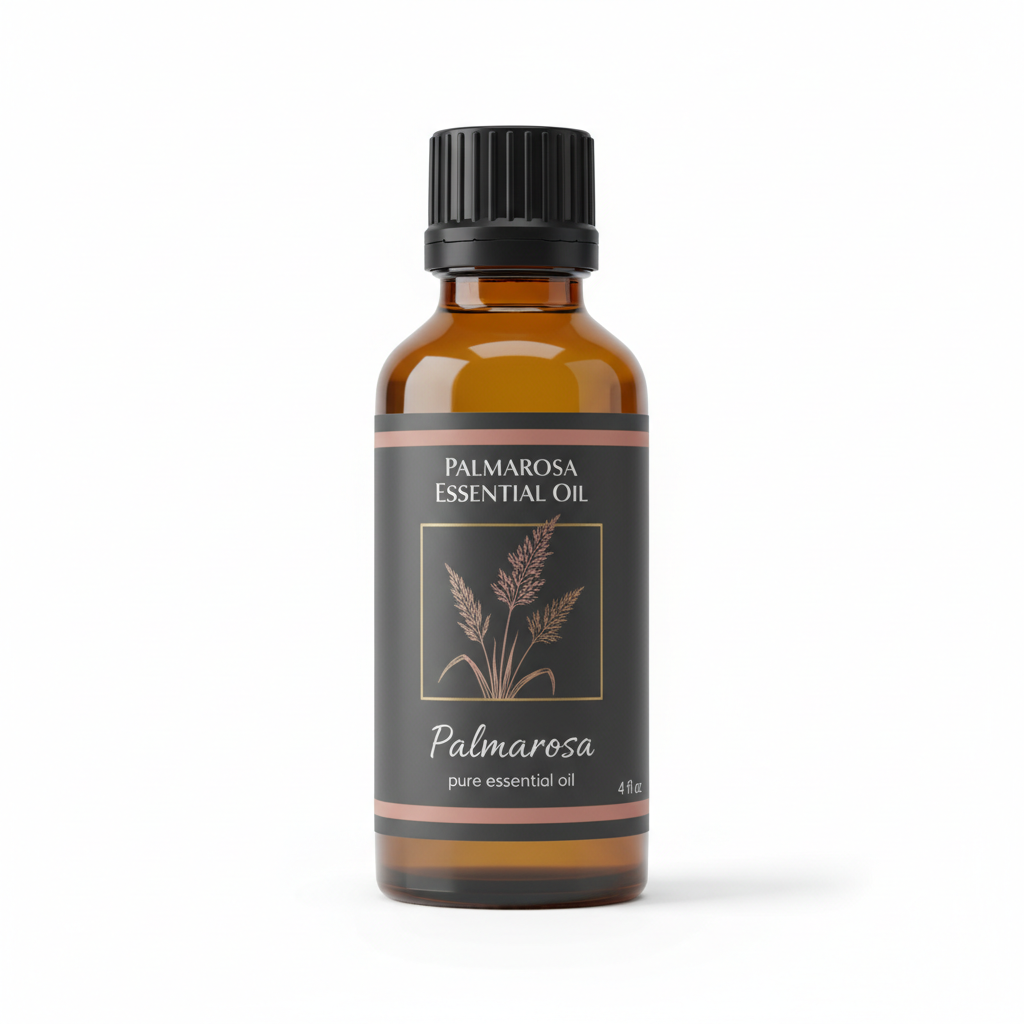
Palmarosa Essential Oil
Our own Palmarosa Essential Oil, in sizes from 0.5 oz to bulk.
From $10.99
Shop Now →What the US rules ask of the word
Under the US organic regulations, an operation that produces or handles products sold as organic generally has to be certified, and selling or labelling a product as organic outside the rules carries a civil penalty (7 CFR § 205.100 - What has to be certified.). There is one exemption worth knowing about. A small operation whose gross organic sales total 5,000 US dollars or less a year is exempt from certification, although it still has to follow the production and labelling rules (7 CFR § 205.101 - Exemptions from certification.). An exempt producer has no certifier for you to look up, so the checking moves to you. That does not make the claim untrue, only harder to verify.
What the label wording means
The composition rules set the tiers, counting by weight or fluid volume and excluding water and salt (7 CFR § 205.301 - Product composition.):
| Label wording | Organic content |
|---|---|
| 100 percent organic | 100 percent organically produced ingredients |
| Organic | Not less than 95 percent |
| Made with organic (specified ingredients) | At least 70 percent, for multi-ingredient products |
A single-ingredient oil can sit at the top of that table. A blend is where the arithmetic matters. Say a roll-on is 1% palmarosa oil in 99% jojoba. If the palmarosa is certified organic and the jojoba is not, the organic share is about 1%, far below 70%, so the product cannot claim either label for itself. If both are certified, it can. That sum is a quick check on any diluted or compounded product that uses the word.
A packaged product labelled organic also has to name the certifying agent that certified the handler of the finished product (7 CFR § 205.303 - Packaged products labeled “100 percent organic” or “organic.”). If the word is on the bottle and the certifier is nowhere to be found, that is worth a question.
What organic does not settle
Organic status is about farming and handling. It does not give you a constituent profile, so a buyer who wants to know how much geraniol is in an oil still needs a gas chromatography report for that lot. It does not make the oil free of residues either. The rules say a product tested and found to contain prohibited substances above 5 percent of the EPA tolerance for that residue must not be sold as organic (7 CFR § 205.671 - Exclusion from organic sale.), which is a threshold for a test that has been run, not a guarantee. And it does not change how the oil behaves on skin. Palmarosa is rich in geraniol whether the grass was organic or not, so the dilution and patch-testing habits in our side effects guide apply in every case.
What to ask, in order
- Is the oil sold as organic, and under which scheme?
- Who is the certifier, and what are the certificate number and expiry date?
- Does the certificate cover the grower, the distiller and the bottler of this product?
- Can the lot you are buying be traced to that certificate?
- If you need composition or residue data, ask for a gas chromatography report and a residue report on the lot, in writing, as a separate question.
A little paper trail goes a long way
If organic matters to you, keep it practical. Ask for the certificate in writing, save the file with the date you received it, and note the lot of the bottle it is meant to cover. Six months later, when you are labelling your own product or answering a customer, you will be glad the answer is in a folder and not in your memory. Certificates have expiry dates, so a quick look at the date is part of the habit.
Do not let the word choose the scent for you
It is easy to treat the word organic as a shortcut for quality, and then forget to smell the oil. The two questions are separate. Whatever the label says, open the bottle and notice whether the scent is the sweet, rosy, gently green aroma you were expecting. A good paper trail and a good scent are both worth having, and neither one stands in for the other.
Where our oil stands
We do not list our palmarosa as certified organic. We sell one palmarosa oil, steam-distilled Cymbopogon martinii, sold neat, and the Certificate of Analysis we publish for one batch lists a relative density of 0.888, a refractive index of 1.473 and an optical rotation of +0.12 degrees, each inside its printed range. It carries no organic information. If certified organic is what you need, ask us in writing through our contact page before ordering, and rely on the certifier name and certificate number rather than on a word.
Our guide to reading a palmarosa label covers the species and origin questions, and our buying guide lists what else to put in writing.
A certificate you can check is worth more than any slogan, on any bottle.
Palmarosa Essential Oil
Palmarosa Essential Oil from our own shop, in sizes from 0.5 oz to bulk.
From $10.99
Shop Now →Sources & Further Reading
- 7 CFR § 205.100 - What has to be certified. Electronic Code of Federal Regulations
- 7 CFR § 205.101 - Exemptions from certification. Electronic Code of Federal Regulations
- 7 CFR § 205.301 - Product composition. Electronic Code of Federal Regulations
- 7 CFR § 205.303 - Packaged products labeled “100 percent organic” or “organic.” Electronic Code of Federal Regulations
- 7 CFR § 205.671 - Exclusion from organic sale. Electronic Code of Federal Regulations