Dandruff and Palmarosa Oil: A Plain Look at the 2025 Study
A 2025 laboratory paper found that palmarosa oil stopped the growth of the yeast linked to dandruff at remarkably small amounts. It is the sort of result that ends up quoted on product pages, and it makes a good story. We sell palmarosa as a fragrant cosmetic oil, not as a dandruff product, so here is a plain reading of what the paper did and what to do about flakes in real life.
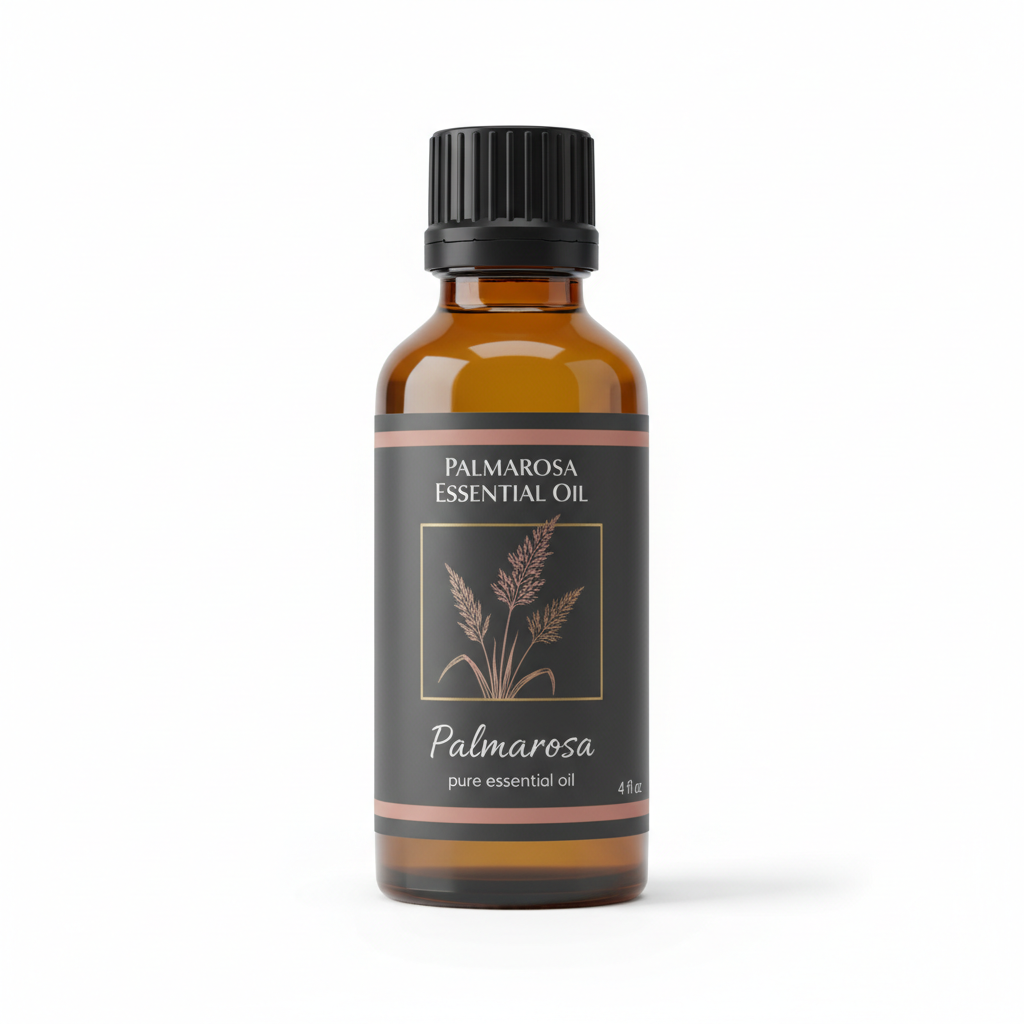
Palmarosa Essential Oil
Our own Palmarosa Essential Oil, in sizes from 0.5 oz to bulk.
From $10.99
Shop Now →Start with what dermatologists recommend
The American Academy of Dermatology says to look for an over-the-counter dandruff shampoo containing zinc pyrithione, salicylic acid, sulfur, selenium sulfide, ketoconazole or coal tar. The instructions depend on the product, but some need to sit on the scalp for up to 5 to 10 minutes before rinsing. For fine, straight or oily hair it suggests using the dandruff shampoo about twice a week, and for coarse, curly or coily hair about once a week if tolerated (AAD, dandruff guidance). Palmarosa oil is not on that list. A pharmacist can help you pick a shampoo, and a dermatologist is the person to see if flaking will not clear.
If flakes are a regular visitor, it helps to treat the shampoo bottle like any other routine product: read the label, follow the timing in the directions, and change one thing at a time so you can tell what is doing what. Most of the frustration with a flaky scalp comes from swapping products every few days and losing track. Keep the scented oils out of that experiment while you work it out.
What the palmarosa paper did
The study screened seven essential oils against two fungi and one bacterium associated with dandruff, using agar diffusion and broth dilution. Two oils inhibited growth significantly, and palmarosa was the most potent. Its minimum inhibitory concentration was between 0.27 and 0.55 milligrams per millilitre for all three organisms. The authors also reported that the oil altered microbial membranes, and that applying it to the skin of rats and rabbits caused no irritation. They suggested it has potential to be developed into a formulation, with further studies needed (Kumari et al., Palmarosa essential oil inhibits the growth of dandruff-associated microbes by increasing ROS production and modulating the efflux pump).
Reading the number in plain terms
Converted to a percentage, 0.27 to 0.55 mg/mL is about 0.03% to 0.06% oil in the liquid the organisms were grown in (our arithmetic). That is tiny, and it is a fair reminder of how potent the oil is. It is also a measurement in a laboratory broth, and a scalp is a different setting, with hair, sebum, rinse water and shampoo all in the way. The paper does not measure how much oil reaches the yeast on a real scalp, how long it stays, or whether anyone's flaking improves. So the number tells researchers the oil is worth studying. It does not turn a bottle of oil into a dandruff shampoo, and it does not tell anyone to apply it for that purpose.
Why a good story travels so fast
A tiny number and the word "potent" make a tidy headline, and it is easy to see why a result like this gets repeated. We love the paper too. But when you meet it on a product page, ask the plain questions: was it a person or a dish, what was the oil mixed into, and does the page say? A study can be a wonderful story and still be one step on a long road.
If you simply love it in your hair care
Some people like a drop of a rosy oil in a hair product for its fragrance, and that is where we would keep palmarosa: as an aroma, well diluted. Our dilution guidance is 0.5% to 2% in a carrier, with a patch test first and the oil kept away from eyes. Palmarosa is mostly geraniol, a recognised fragrance allergen, and IFRA's geraniol standard allows 0.78% geraniol in hair products (IFRA, Geraniol standard, 51st Amendment). With the typical 82.4% geraniol that IFRA lists for palmarosa oil (IFRA, The Annex on contributions from other sources to the IFRA Standards), that is about 0.95% oil by our arithmetic. Two percent is above that figure, so we start at 0.5% for anything going near the scalp.
Our hair and scalp article covers carrier oils and technique, and our dilution chart converts percentages into weights.
Keeping the scent in its place
If you mix your own hair product, smell the oil on a paper strip first. Palmarosa is sweet, rosy and gently green, and a little goes further than you expect, so start lower than you think you need and add only if the scent is too faint. Measuring with a small scale rather than counting drops keeps one batch the same as the next, and writing the percentage on the bottle means you never have to remember it.
When flakes are not just flakes
An itchy, flaking scalp is not always dandruff. The AAD's guide to an itchy scalp lists other causes, among them an allergic reaction to a hair product, scabies and scalp ringworm, and says scabies treatment needs a prescription (AAD, 10 reasons your scalp itches and how to get relief). A new product, fragrance oils included, is worth stopping if a rash or burning appears. For flaking that persists or becomes severe, that comes with a rash, or that you cannot explain, see a dermatologist. For related questions, our article on fungal skin concerns takes a similar look at the lab evidence.
The lab result makes palmarosa a fascinating oil to read about. For flaking, a proper dandruff shampoo and a quick word with a pharmacist are the straightforward route.
If you remember one thing from this paper, let it be the pleasure of reading it. Keep the oil on the shelf for the moments you want a rosy aroma, and let the shampoo aisle handle the flakes.
Palmarosa Essential Oil
Palmarosa Essential Oil from our own shop, in sizes from 0.5 oz to bulk.
From $10.99
Shop Now →Sources & Further Reading
- American Academy of Dermatology. Dandruff guidance page
- American Academy of Dermatology. 10 reasons your scalp itches and how to get relief
- Kumari KU et al., 2025. Palmarosa essential oil inhibits the growth of dandruff-associated microbes by increasing ROS production and modulating the efflux pump. Microb Pathog
- IFRA. Geraniol standard, 51st Amendment
- IFRA. The Annex on contributions from other sources to the IFRA Standards, 51st Amendment