Palmarosa Oil and Acne: What the Lab Study Found
Search for palmarosa and acne and you will find one paper that gets quoted again and again. It is a laboratory study, and it is a genuinely interesting one, so it deserves a plain-English reading. We sell palmarosa as an external, cosmetic oil with a lovely rosy aroma, not as an acne product, and nothing here is advice for treating acne.
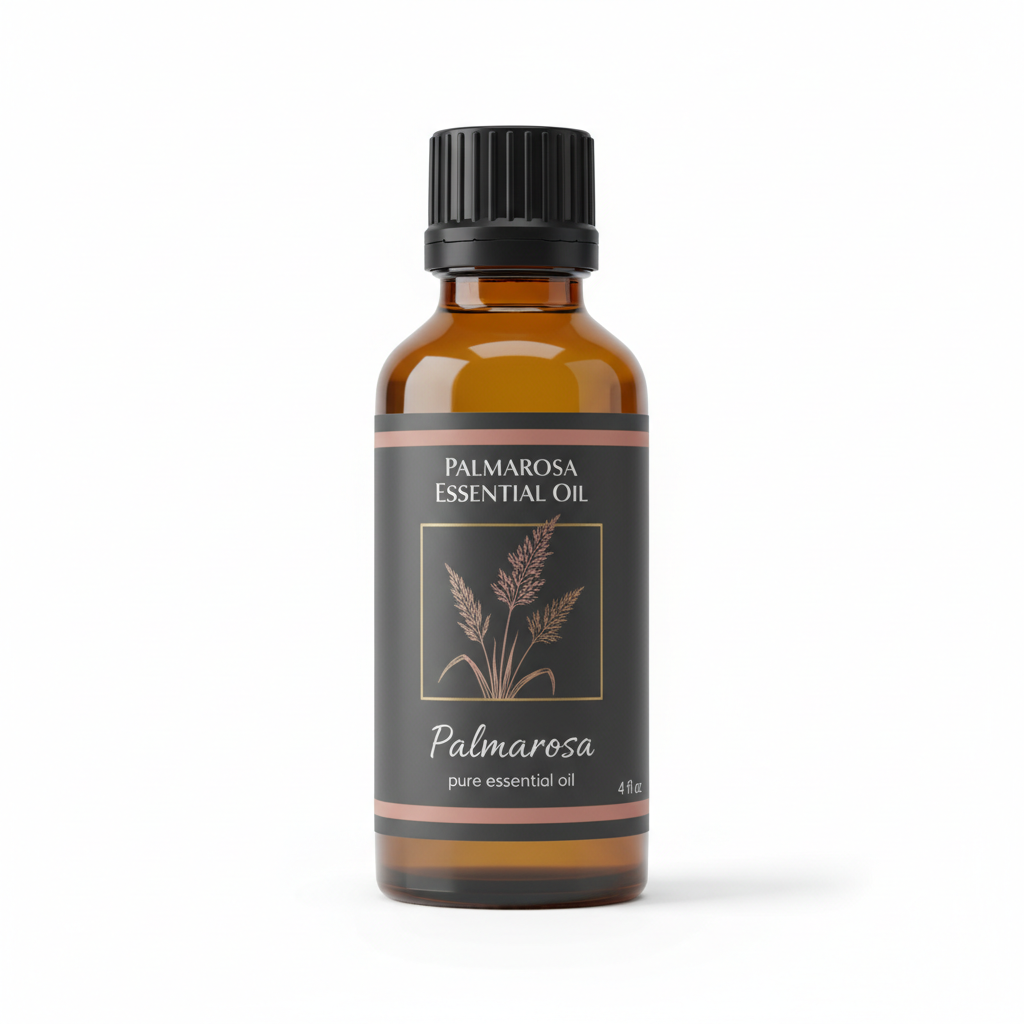
Palmarosa Essential Oil
Our own Palmarosa Essential Oil, in sizes from 0.5 oz to bulk.
From $10.99
Shop Now →What the study measured
In 2021, Mahant, Sahajpal and Nanda published a study of palmarosa oil as a possible topical ingredient for acne (Insights into the mechanism of Cymbopogan martinii essential oil in topical therapy of acne vulgaris). They analysed the oil and found geraniol was its major component. They then tested it against Cutibacterium acnes, a bacterium found on skin. The lowest concentration that stopped the bacteria growing, and the lowest that killed them, were both 16 microlitres per millilitre. In cell work, the oil also lowered several inflammation-related signalling proteins and blocked tyrosinase, an enzyme involved in pigment production. The authors concluded the oil may prove useful as a natural topical agent.
It is a good paper for what it is. It shows palmarosa oil is biologically active in a dish, which fits an oil that is mostly geraniol.
How to read a study like this
When you come across a headline paper, it helps to ask three simple questions: who or what was tested, in what form, and for how long. Here the answers are bacteria and cells in a lab, a specific concentration of oil in liquid, and a short time frame. None of that is a criticism; it is just a reminder that lab work is the first step and not the last.
It is a bit like reading a recipe and a restaurant review: they are both interesting, but they are not the same as eating the dish. We find it helpful to hold on to that, especially when a bottle's marketing leans on a single paper.
From a dish to your skin
A dish and a face are very different places. The abstract reports no people and no skin trials, so it tells us how the oil behaves in a lab, not what it does on a face. The unit conversion is also useful: 16 microlitres in a millilitre is 1.6% oil by volume. The bacteria in that test were sitting in liquid at 1.6% oil, while a leave-on face oil would normally be far more dilute, and it would spread over skin, partly evaporate and mix with sebum. That is our reasoning from the paper's numbers, not a measurement.
Acne itself involves more than bacteria. The AAD notes that with a dermatologist's help virtually everyone can see clearer skin, and that it takes at least 6 to 8 weeks of sticking with a treatment plan before breakouts start to lessen (AAD, Acne: Diagnosis and treatment). Over-the-counter products exist, benzoyl peroxide among them, and a dermatologist or pharmacist is the right person to talk to about them. If breakouts are persistent, painful or leaving marks, book an appointment with a dermatologist.
If you keep a skin routine, a simple one usually works better than a crowded one. Add one new product at a time so that you know what is responsible if your skin objects to anything, and give each plenty of time before you judge it.
If you like palmarosa for its scent
A drop of a rosy oil in a body or face oil is a pleasure for the aroma alone. If that is what you are after, the practical points matter more than the lab number.
- Dilute properly. Our guidance is 0.5% to 2% in a carrier oil. On the face we start at 0.5%, which is about 3 drops in an ounce of carrier (rough arithmetic at 20 drops per ml).
- Know why we start low. IFRA's geraniol standard allows 0.78% geraniol in a facial moisturiser. With a typical 82.4% geraniol in palmarosa oil, that works out to about 0.95% oil (IFRA, Geraniol standard, 51st Amendment). The typical figure comes from IFRA's annex, so it describes the oil class, not our bottle. Two percent sits well above it, which is why we suggest the lower end for leave-on face use.
- Patch test first. Geraniol is a recognised fragrance allergen. Test a little diluted oil on a small patch before using it more widely, and stop if skin stings, burns or reddens.
- Leave irritated skin alone. Skin that is already inflamed is better left without a new fragrance. Our side effects and patch testing guide explains the details.
Our carrier oil guide covers the base side of a blend, and our dilution chart turns percentages into weights.
So the palmarosa acne paper is a fascinating glimpse of what is in the oil, and a good reason to enjoy it for its aroma, diluted and patch tested.
Palmarosa Essential Oil
Palmarosa Essential Oil from our own shop, in sizes from 0.5 oz to bulk.
From $10.99
Shop Now →Sources & Further Reading
- Mahant S, Sahajpal NS, Nanda S, 2021. Insights into the mechanism of Cymbopogan martinii essential oil in topical therapy of acne vulgaris. Future Microbiol
- American Academy of Dermatology. Acne: Diagnosis and treatment
- IFRA. Geraniol standard, 51st Amendment
- IFRA. The Annex on contributions from other sources to the IFRA Standards, 51st Amendment