Palmarosa Dilution Chart: How Much Oil per Ounce?
Percentages are the unit that matters when you dilute palmarosa oil. Drops are friendly, but they can hide a two-to-one error without you noticing. This page turns percentages into millilitres, drops and grams, then sets them beside published limits so you can pick a sensible row for what you are making.
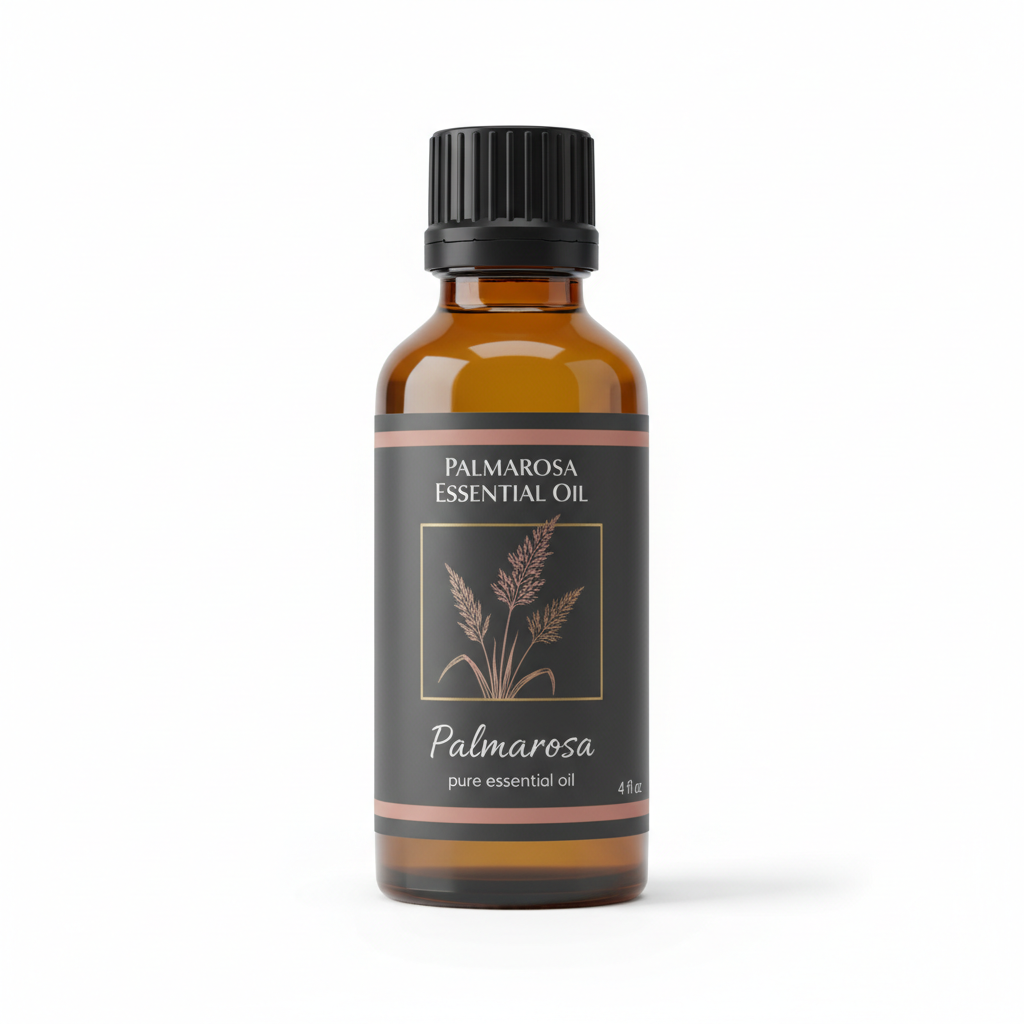
Palmarosa Essential Oil
Our own Palmarosa Essential Oil, in sizes from 0.5 oz to bulk.
From $10.99
Shop Now →Why we start from the percentage
The Tisserand Institute notes that conversion rates using drops are always approximate, because no two drops of essential oil are the same (Tisserand Institute, Dilution for essential oils). A dropper's tip, angle and the oil's thickness all change the size of a drop. Ten drops in a 1 oz (29.57 ml) bottle is 1.7% oil at 20 drops per ml, 2.3% at 15 drops per ml and 1.1% at 30 drops per ml. Those three droppers are illustrative, but the spread is wider than the gap between our low and high ends.
Our suggestion is to choose the percentage first, then weigh the oil on a scale that reads to 0.01 g. The Certificate of Analysis we publish for one batch measured a relative density of 0.888 at 20 C, so 1 ml of that batch is about 0.888 g, which is a figure for that batch rather than a guarantee for every lot.
The chart
Amounts below are oil as a percentage of the finished carrier blend, at 20 drops per ml. Oil and carrier differ slightly in density, so a weighed recipe will land a touch differently.
| Oil % | In 10 ml | In 1 oz (29.57 ml) | In 100 ml | Grams in 1 oz |
|---|---|---|---|---|
| 0.2% | 0.02 ml, under 1 drop | 0.06 ml, 1 drop | 0.2 ml, 4 drops | 0.05 g |
| 0.5% | 0.05 ml, 1 drop | 0.15 ml, 3 drops | 0.5 ml, 10 drops | 0.13 g |
| 1% | 0.1 ml, 2 drops | 0.30 ml, 6 drops | 1 ml, 20 drops | 0.26 g |
| 1.5% | 0.15 ml, 3 drops | 0.44 ml, 9 drops | 1.5 ml, 30 drops | 0.39 g |
| 2% | 0.2 ml, 4 drops | 0.59 ml, 12 drops | 2 ml, 40 drops | 0.53 g |
Small bottles are where drop counting misleads most. One drop in a 10 ml roller is already 0.5%, and one extra drop doubles it. Make the blend in a larger batch, weigh it, and decant.
Choosing a row
Our dilution guidance is 0.5% to 2% in a carrier oil, with a patch test first and the low end for the face. Two published sources help you pick within that range. The Tisserand Institute gives general ranges for essential oils (not palmarosa figures): 0.2% to 1% for sensitive or impaired skin, 0.5% to 1.2% for facial cosmetics and deodorants, 1% to 3% for body oils and lotions, and 2% to 4% for bath products.
IFRA's geraniol standard sets maximum geraniol in the finished product by category, naming dermal sensitization and systemic toxicity as the properties behind the limits (IFRA Standard: Geraniol, Amendment 51). It allows 0.78% for face moisturizer, 1.2% for body creams, oils and lotions, 0.94% for hand cream, 1.1% for products applied to the face with the fingertips, 0.25% for underarm and body-spray products, and 2.8% for rinse-off products (Guidance for the Use of IFRA Standards). IFRA lists palmarosa oil at a typical 82.4% geraniol (Annex on contributions from other sources to the IFRA Standards). Dividing a cap by 0.824 gives the most oil that keeps geraniol inside it:
- Face moisturizer: about 0.95%
- Hand cream: about 1.14%
- Face with fingertips: about 1.33%
- Body oil or lotion: about 1.46%
- Underarm or body spray: about 0.30%
- Rinse-off: about 3.4%
That is our arithmetic from a typical composition, not a statement about our oil, since the Certificate of Analysis we publish carries density, refractive index and optical rotation and no constituent data. IFRA is an industry code rather than law, and the pattern is clear: the top of our 0.5% to 2% range sits above several of these ceilings, because 2% oil brings about 1.65% geraniol. So for leave-on skin products we start low, around 0.5% for the face and up to 1% for the body, and we treat 2% as a figure for rinse-off or non-skin uses, never as a safe level for a leave-on blend.
If you add too much
You cannot fix a strong blend by pouring some out, because concentration stays the same. You fix it with more carrier: carrier to add equals current volume times (current percent divided by target percent, minus 1). A full 1 oz bottle at 2% needs about 29.6 ml of carrier to reach 1%, and about 88.7 ml to reach 0.5%. The easier route is to pour off half and refill with carrier. If a rash appears, Poison Control advises stopping use immediately and gently washing it off (Essential oils: Poisonous when misused), and our patch testing article covers what comes next.
A habit worth keeping
Write the percentage on the bottle the moment you finish mixing, along with the date and a short name. A blend labelled "palmarosa 0.5%, 12 March" is easy to trust next month; an unmarked bottle is a guess. If you make the same blend regularly, keep a small card with the weights beside your scale so you are never doing the arithmetic in a hurry.

What the chart leaves out
It describes healthy adult skin. For children, pregnancy, pets or broken skin, the right guide is a clinician or veterinarian: see our posts on children and pregnancy. We sell the oil neat and no carrier, and our carrier oil comparison says what to look for at a supply shop. Pick the percentage, weigh the oil, and write the number on the bottle.
Palmarosa Essential Oil
Palmarosa Essential Oil from our own shop, in sizes from 0.5 oz to bulk.
From $10.99
Shop Now →Sources & Further Reading
- Tisserand Institute. Dilution for essential oils. tisserandinstitute.org
- IFRA. IFRA Standard: Geraniol (Amendment 51), 2023. IFRA_STD_037.pdf
- IFRA. Annex on contributions from other sources to the IFRA Standards, 51st Amendment. ifra-51st-amendment-annex.xlsx
- IFRA. Guidance for the Use of IFRA Standards, 51st Amendment, 2023. ifra-51st-amendment-guidance.pdf
- Poison Control. Essential oils: Poisonous when misused. poison.org