Palmarosa Face Oil: How Much to Add, Worked by Weight
A face oil is about as simple as skincare gets: a carrier oil you like, and a little scent. Palmarosa is lovely in one, because its sweet, rosy, gently green aroma is delicate enough for the face without overpowering it. The one number worth getting right is how much to add, and the fragrance industry's own limits give a clear answer.
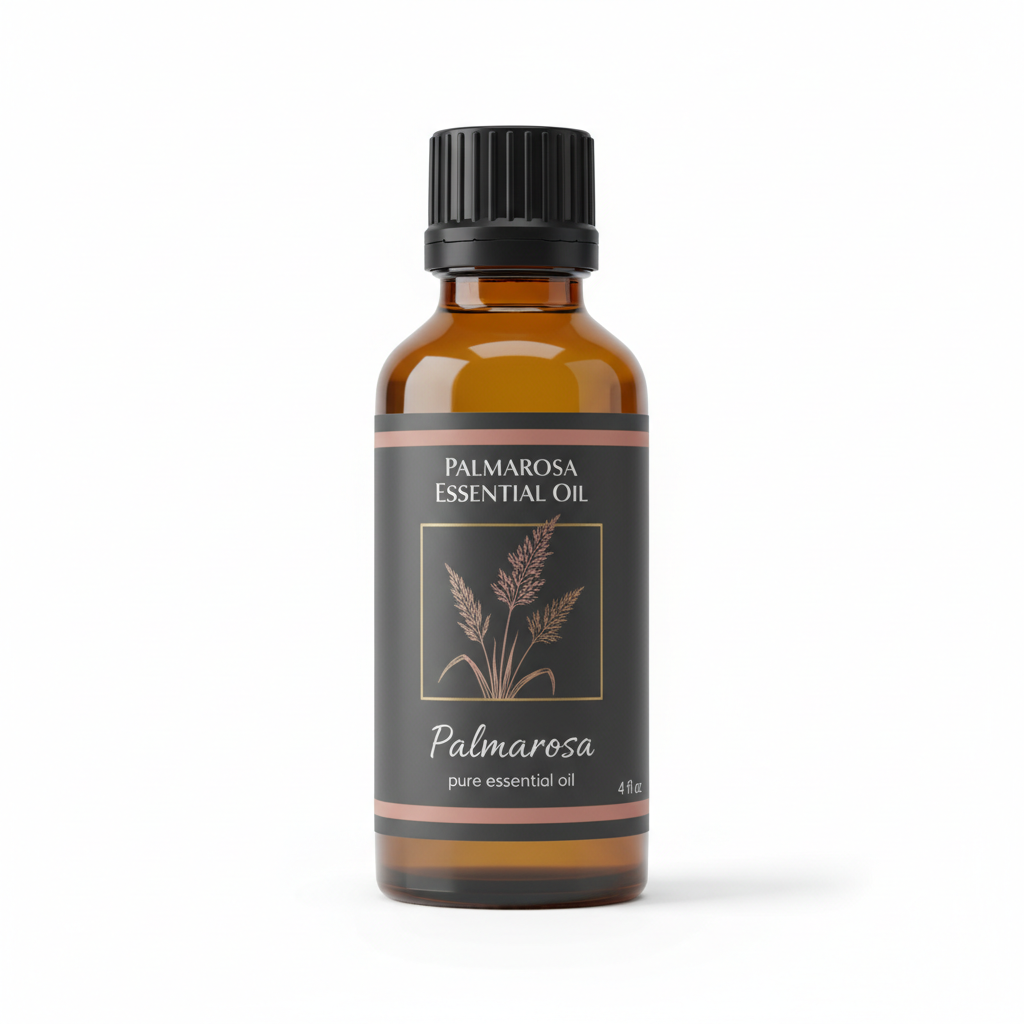
Palmarosa Essential Oil
Our own Palmarosa Essential Oil, in sizes from 0.5 oz to bulk.
From $10.99
Shop Now →The number that matters
IFRA's geraniol standard sets the maximum geraniol in a finished product by category, and facial moisturizers fall in category 5B at 0.78% (IFRA, 2023). Body creams, oils and lotions sit in 5A at 1.2%. IFRA's guidance does not list a face oil by name, so we use the stricter face category, which is the cautious choice (IFRA guidance). Palmarosa oil's typical geraniol content is 82.4% (IFRA annex), so multiplying the oil share by 0.824 tells you how much geraniol it brings.
| Oil in the blend | Geraniol it brings | Against the 0.78% face limit |
|---|---|---|
| 0.5% | 0.41% | well under |
| 0.9% | 0.74% | just under |
| 1.0% | 0.82% | over |
| 2.0% | 1.65% | more than twice the limit |
That puts the ceiling for the oil near 0.95%. These are our arithmetic from typical values, not measurements of any bottle. The certificate we publish for one batch lists density, refractive index and optical rotation, so if you need a geraniol figure for a lot, ask us in writing through the contact page before you order.
We recommend diluting our palmarosa to between 0.5% and 2% in a carrier oil and starting at the lower end for the face. The table shows why that matters: 0.5% suits the face nicely, and 2% sits well above the limit for a face product. The Tisserand Institute's general ranges agree, with 0.5% to 1.2% for the face and 0.2% to 1% for sensitive skin (Tisserand Institute). Our suggestion is 0.5% for a first batch and 0.9% as the most you would write down.
Smell it before you blend it
Before any weighing, take the cap off and smell the bottle on its own. You'll notice the sweet, rosy centre first, then a green, grassy edge, and somewhere behind it a soft lemony hint. Learning that smell now makes it easier to judge later whether you have added too much, because a face oil should only whisper.
At half a percent the scent is quiet: hold the bottle near your face and you catch a gentle rose, not a perfume counter. If it seems faint, resist the urge to add more drops. Keep the weighed number, and let the carrier you love do the talking.
What the oil does, and what it does not
Most of what a face oil does for the skin comes from the carrier, and that is where your choice matters. The palmarosa brings the scent and nothing else, and we make no claim beyond that. Our carrier oil guide looks at shelf life and allergens first, and you will find the carrier at a pharmacy, grocery or cosmetic supplies shop. If your skin tends toward dryness or shine, take a look at our dry skin and oily skin articles.
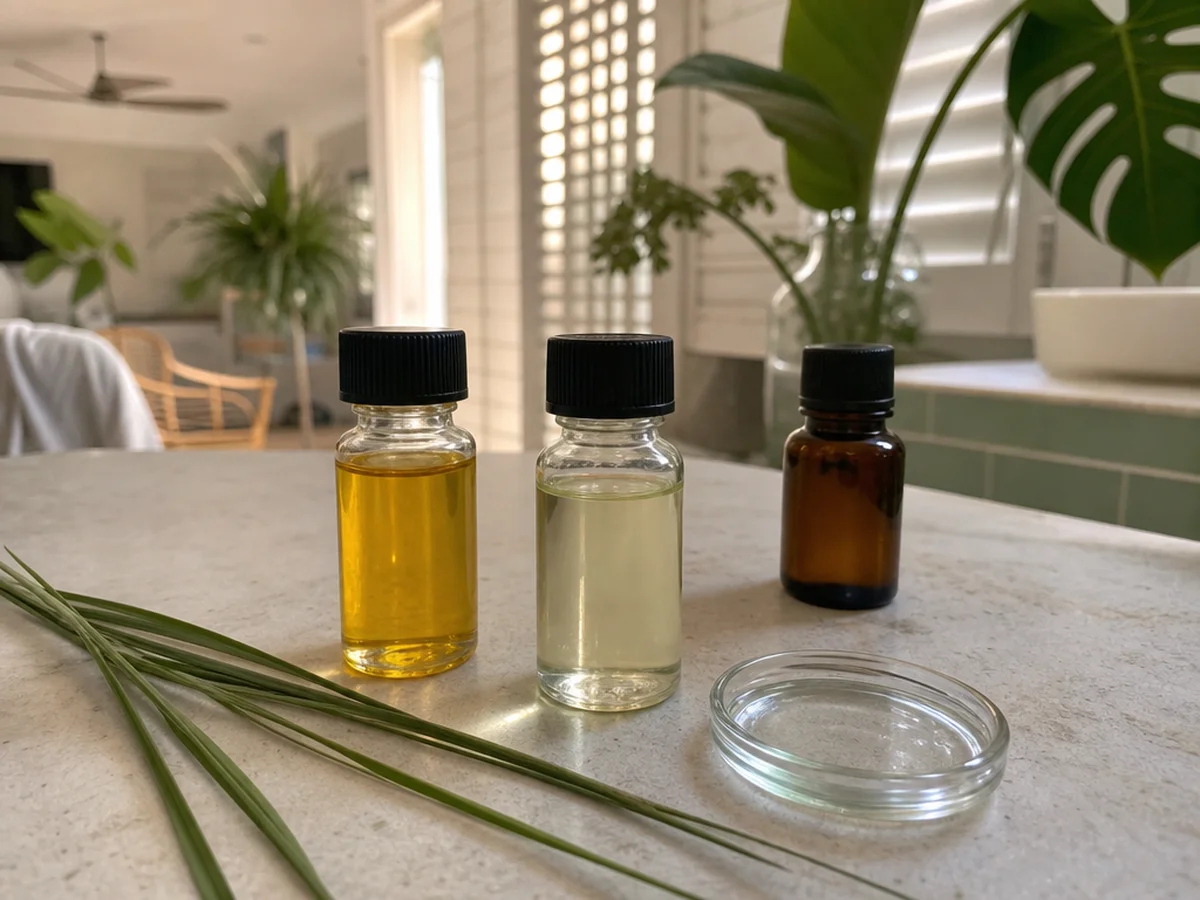
Weighing it out
Weigh rather than count drops. We use the density on the certificate (0.888, so 1 ml weighs about 0.888 g) and the rough convention of 20 drops per ml, but the Tisserand Institute notes that drop conversions "are always approximate", and droppers vary.
| Batch | At 0.5% | At 0.9%, the most we would use |
|---|---|---|
| 30 g | 0.15 g (about 3 drops) | 0.27 g (about 6 drops) |
| 100 g | 0.50 g (about 11 drops) | 0.90 g (about 20 drops) |
The carrier makes up the rest, so for 30 g at 0.5% that is 29.85 g. Wash and dry a small dark glass dropper bottle first, weigh in the carrier, add the palmarosa, cap and swirl. Label it with the percentage and the date, and pour from the dropper rather than dipping your fingers in. The FDA lists contaminated water and fingers dipped into products among the common causes of contaminated cosmetics, and a dry bottle with no water in the blend keeps those risks low (FDA).
Small batches suit this oil. Geraniol that has been exposed to air forms new compounds, and in a mouse test the air-exposed samples were moderate sensitizers where pure geraniol was weak (Hagvall et al., 2007). That was geraniol on its own and in mice, so applying it to a bottle of face oil is our reasoning, but it is a good argument for a 30 g batch you finish in a few weeks and a tightly closed oil bottle.
Choosing a bottle you will enjoy using
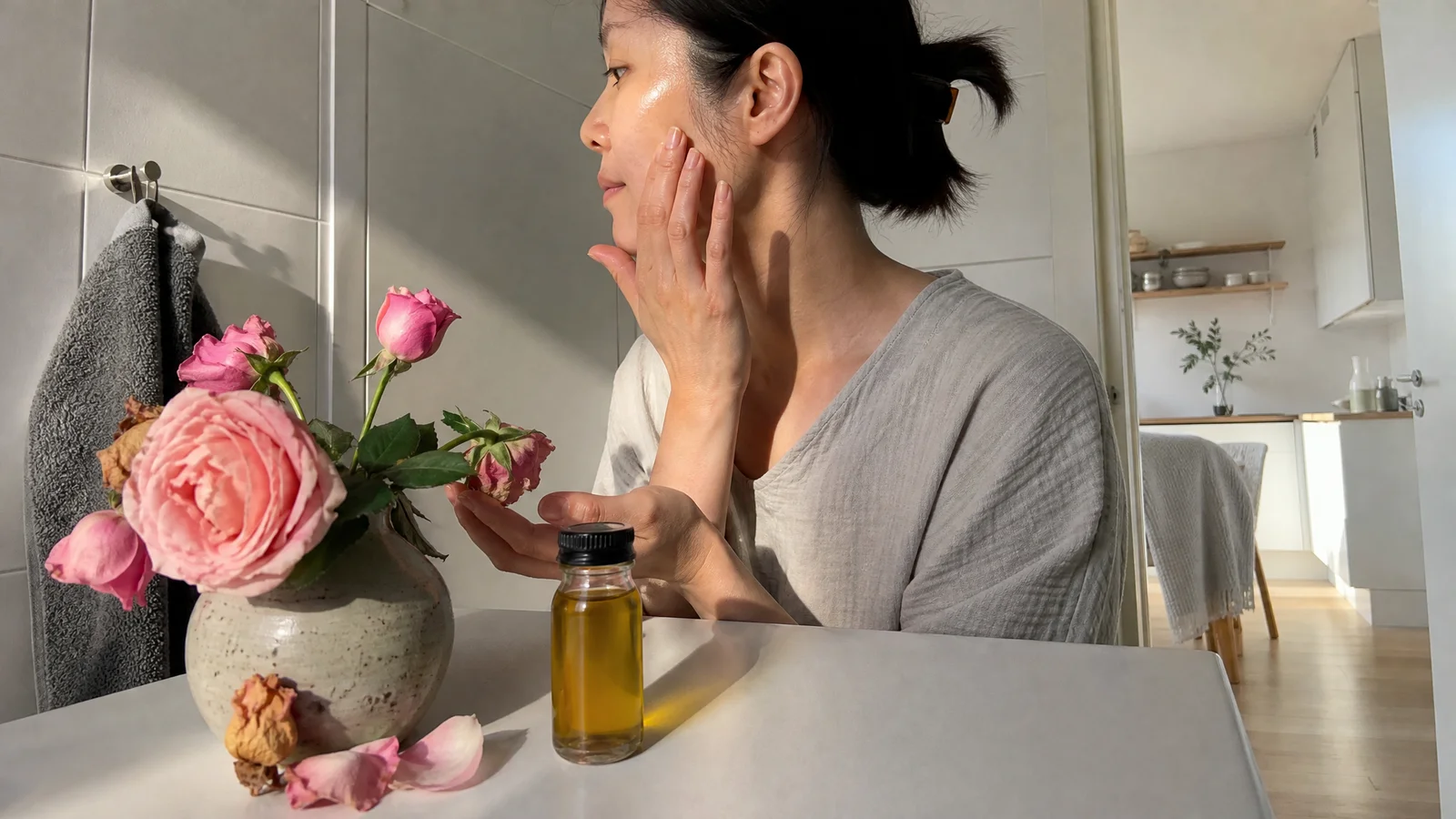
A small amber or cobalt glass bottle with a dropper feels good in the hand and keeps the oil out of the light. Pick one with a dropper that is easy to squeeze gently, so you are not wrestling a stiff rubber bulb at the bathroom sink. It is a tiny detail, but a pleasant bottle is the difference between a face oil you reach for and one that sits in a drawer.
Patch test, and who should skip it
A clinical patch test is longer than a dab on the arm: the FDA describes the allergen covered on the skin for 48 hours and checked after 72 to 96 hours, over two to three visits (FDA). Our home suggestion is to put a little of the finished oil on the inner forearm twice a day for several days before using it on the face, and to stop at any redness, itching or swelling. It lowers the odds of a surprise without clearing you completely. Keep the oil away from the eyes, including the skin right at the lid.
If you have eczema, broken skin or a history of reacting to fragranced products, ask a dermatologist or allergist first; our sensitive skin article has more. Keep the oil from children and pets and never swallow it. For a higher ceiling on the body, the water-free body butter is a better format, and the dilution chart has the wider conversions.
The whole recipe fits in one sentence: a carrier you love, about half a percent of palmarosa, and a scale. Ask any recipe that wants more where its number came from.
Palmarosa Essential Oil
Palmarosa Essential Oil from our own shop, in sizes from 0.5 oz to bulk.
From $10.99
Shop Now →Sources & Further Reading
- IFRA Standard: Geraniol, 2023 (Amendment 51)
- Annex on contributions from other sources to the IFRA Standards, 51st Amendment
- Guidance for the Use of IFRA Standards, 51st Amendment (June 30, 2023)
- Tisserand Institute, Dilution for essential oils
- FDA, Microbiological Safety and Cosmetics
- Hagvall L et al., 2007. Fragrance compound geraniol forms contact allergens on air exposure. Identification and quantification of oxidation products and effect on skin sensitization. Chem Res Toxicol
- FDA, Allergens in Cosmetics