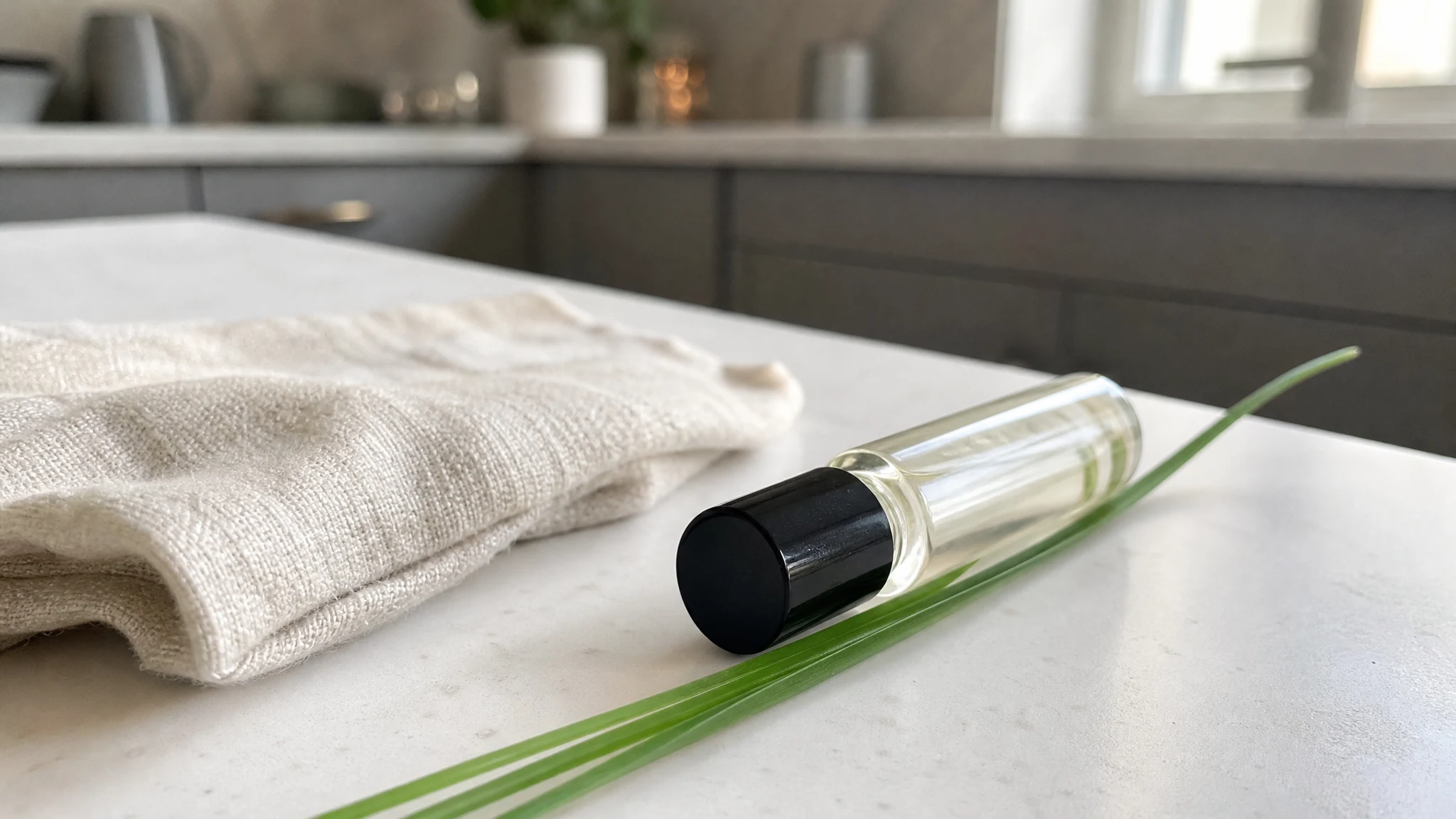
Palmarosa Roller Bottle Recipes: 3 Gentle Blends
A 10 ml roller bottle is tiny, and that is its charm and its trap. One drop is half a percent, so a few extra drops change the strength a lot. Here are three palmarosa rollers built to stay gentle: one on its own, one with bergamot, one with geranium.
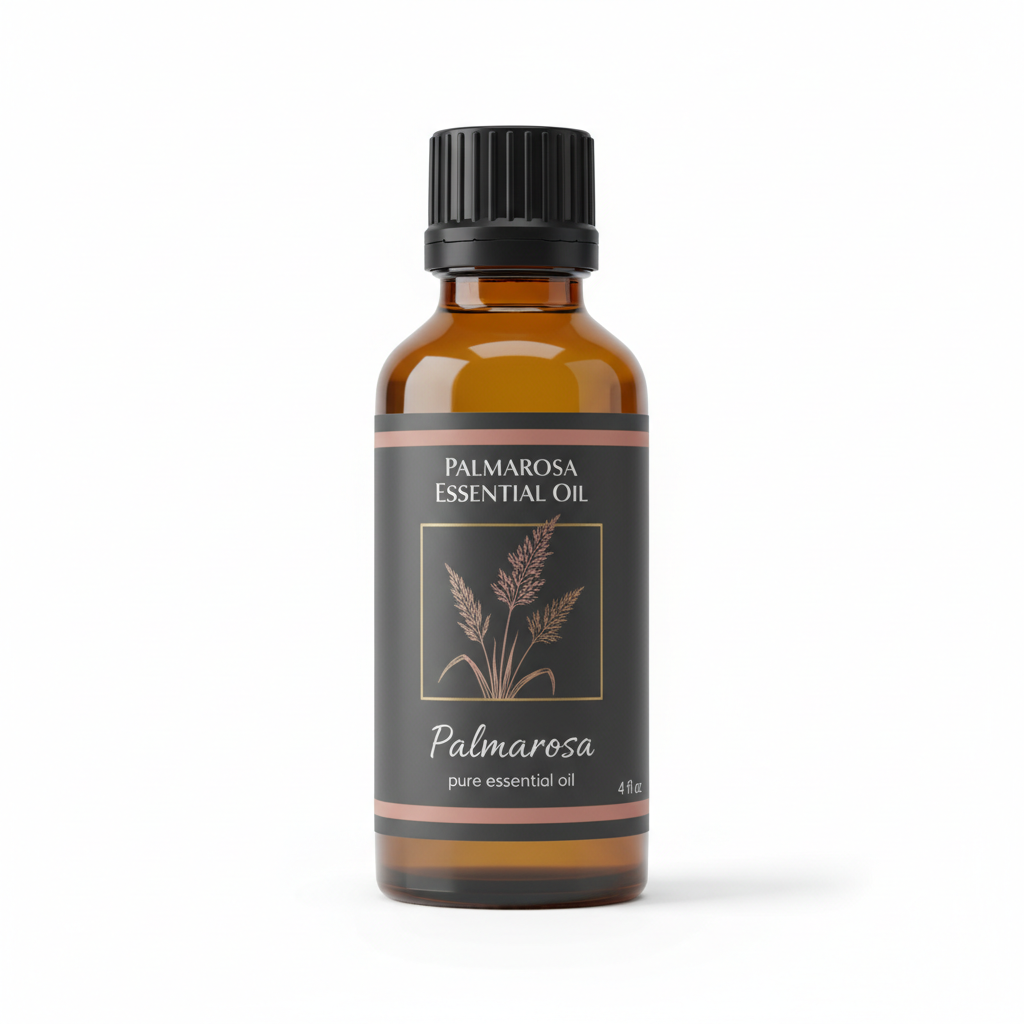
Palmarosa Essential Oil
Our own Palmarosa Essential Oil, in sizes from 0.5 oz to bulk.
From $10.99
Shop Now →Why we keep roller bottles low
Recipes online often run rollers at 3% to 10%, and the Tisserand Institute does list 3% to 10% as a range for "feel good" rollerballs (Dilution for essential oils - Tisserand Institute). Palmarosa is a different case because it is rich in geraniol, a fragrance ingredient IFRA caps by product type. At a typical 82% geraniol, the cap for body creams, oils and lotions (1.2% geraniol) works out to about 1.46% palmarosa, and the cap for face moisturizers (0.78%) to about 0.95% (IFRA Standard, Geraniol, 2023 (Amendment 51)). Those are our calculations from a typical composition. Our own skin guidance is 0.5% to 2% in a carrier with a patch test, and for rollers we would stay at 1% palmarosa, wrists and body only, and keep rollers away from the face.
The drop arithmetic
Using the density of 0.888 on the Certificate of Analysis we publish for one batch, and the rough convention of 20 drops to the millilitre, two drops of palmarosa is about 0.1 ml, which is 1% of a 10 ml bottle. Droppers vary, so call it an estimate. A scale reading to 0.01 g is more reliable: 1% of 10 g is 0.1 g. The rest of the bottle is carrier oil from a craft shop, pharmacy or grocery; jojoba and sweet almond are the two we mention for skin.
| Blend | Oils | Total oil | Carrier |
|---|---|---|---|
| 1. Palmarosa on its own | 2 drops palmarosa | about 1% | about 9.9 ml |
| 2. Palmarosa and bergamot | 2 drops palmarosa, 2 drops furanocoumarin free bergamot | about 2% | about 9.8 ml |
| 3. Palmarosa and geranium | 2 drops palmarosa, 2 drops geranium | about 2% | about 9.8 ml |
We don't sell bergamot or geranium; they appear because they pair beautifully with palmarosa. Our pairing guide goes into the scent side.
Choosing your carrier
Any carrier you already like on your skin will do, and a light one suits a roller best. Jojoba and sweet almond are the two we mention, and you will find them at a pharmacy, grocery or craft shop. Pick a fresh bottle and check that it smells clean, because the carrier is more than 98% of what rolls onto your wrist.
Start with blend one
The single oil roller is the one we would make first. With just palmarosa in the bottle, any reaction has one possible culprit, and you get to know the scent properly: sweet, rosy, a little grassy, with a lemony flicker. Once it has been worn comfortably, move on to the blends.
Adding bergamot
Ordinary bergamot contains bergapten, a compound that makes skin more reactive to sunlight. The Tisserand Institute says bergamot oil should be limited to a maximum of 0.4% in the final product on skin exposed to sunshine, and that bergapten-free bergamot, called FCF for furanocoumarin free, is considered non-phototoxic (Phototoxicity: essential oils, sun and safety). Two drops of regular bergamot in 10 ml would be about 1%, so blend two calls for FCF. Ask your supplier for its IFRA statement, which lists its allergen content.
Adding geranium
Geranium is a natural partner, with the same rose character in a different voice. By IFRA's typical figures, geranium oil carries about 17.7% geraniol against palmarosa's 82.4% (IFRA's annex on contributions from other sources, 51st Amendment, 2023). One percent of each puts the bottle at roughly 1.0% geraniol by our arithmetic, under the 1.2% body cap but above the face cap. That is one more reason these rollers are for the body and not the face. If you want more geranium, ask its seller for an IFRA statement first and add up the percentages before adding drops.
How it wears
A roller is a close-up scent. Roll it on, wait a moment, and bring your wrist to your nose: you'll notice the sweet rose first, then the green, grassy part, with that lemony flicker at the edge. It sits near the skin instead of filling a room, which is exactly its charm. If you find yourself wanting more, resist adding drops to the bottle and roll on an extra pass at the next wear instead, since the arithmetic above is what keeps the blend gentle.
Making and testing it
- Drop the essential oils into a clean, dry bottle first, then top up with carrier oil.
- Fit the roller ball, cap and tip the bottle gently a few times.
- Patch test a dab on the inner forearm and wait a day. A clinical patch test is a longer process, as FDA notes (Allergens in Cosmetics), so treat your own test as a screen.
- Roll onto a small patch of skin, away from eyes and broken skin, and keep the bottle from children and pets. Never swallow it.
Label it and keep it cool
A 10 ml bottle has no room for a long label, so write the blend number, the strength and the date on a small sticker. Keep the finished roller in a drawer or a bag, away from sun and heat, and never leave it in a hot car. If you make all three blends, the labels are how you will tell them apart a month from now.
Rollers carry a scent close to the skin and are not meant to fill a room. For that, try a diffuser or read about palmarosa in natural perfumery. If you react, wash the area and ask a dermatologist or allergist.
A small bottle of rose-green scent in a pocket is one of the nicest ways to enjoy this grass, as long as the arithmetic stays gentle.
Palmarosa Essential Oil
Palmarosa Essential Oil from our own shop, in sizes from 0.5 oz to bulk.
From $10.99
Shop Now →Sources & Further Reading
- Tisserand Institute. Dilution for essential oils - Tisserand Institute. tisserandinstitute.org/dilution-essential-oils
- Tisserand Institute. Phototoxicity: essential oils, sun and safety. tisserandinstitute.org/safety/phototoxicity
- IFRA Standard, Geraniol, 2023 (Amendment 51). IFRA_STD_037.pdf
- IFRA, 2023. Annex on contributions from other sources to the IFRA Standards, 51st Amendment. ifra-51st-amendment-annex.xlsx
- FDA. Allergens in Cosmetics. fda.gov