Palmarosa Hair Oil: A Pre-Wash Recipe in Drops
A pre-wash hair oil is one of the oldest and loveliest bits of hair care: warm oil worked through the lengths before you shampoo. Palmarosa makes it smell like a rose garden. The thing worth knowing is that the carrier does the work for your hair, and palmarosa is there for the scent, so we start with the carrier.
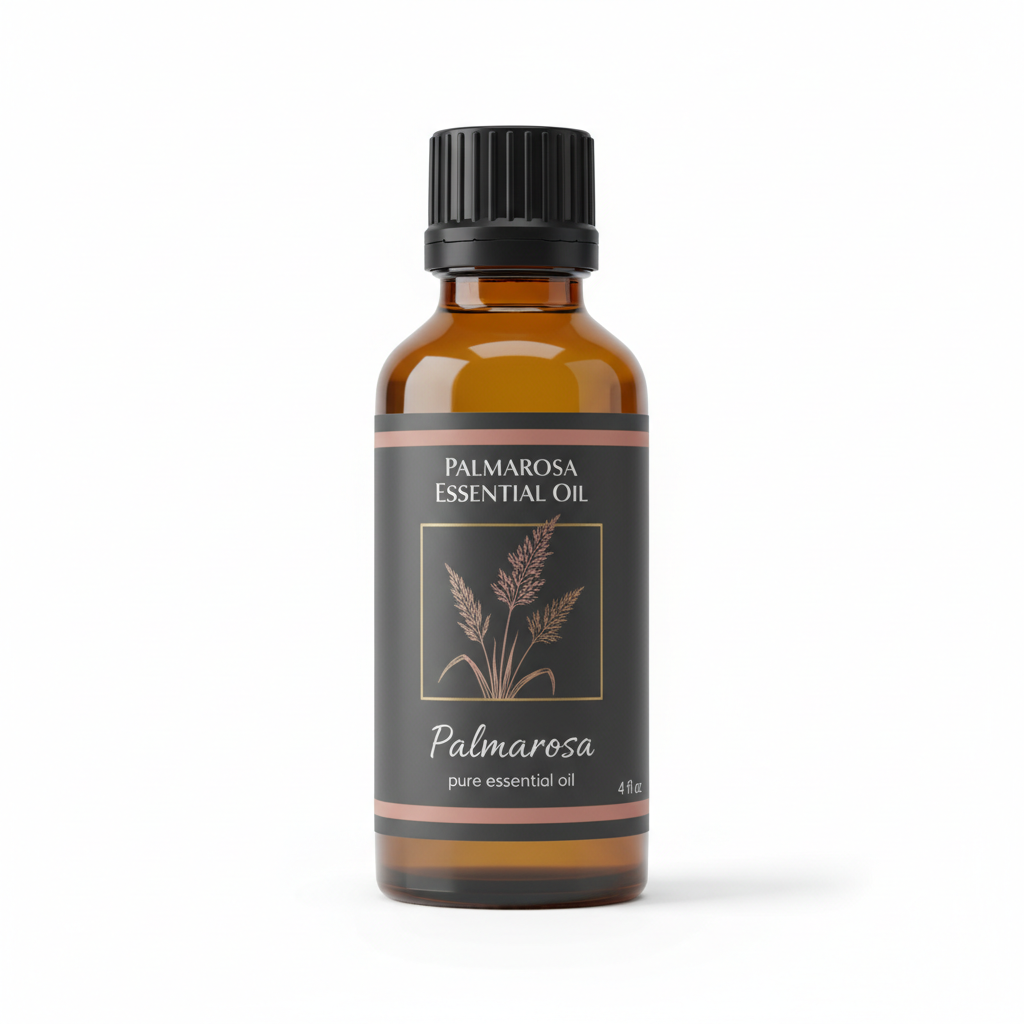
Palmarosa Essential Oil
Our own Palmarosa Essential Oil, in sizes from 0.5 oz to bulk.
From $10.99
Shop Now →Choose the carrier first
The most useful controlled comparison we know of tested three oils on hair: mineral oil, sunflower oil and coconut oil. Used before and after washing on damaged and undamaged hair, coconut oil was the only one of the three that markedly reduced protein loss from combing. The authors explain that coconut oil is mostly lauric acid triglyceride, which has an affinity for hair protein and is small and straight enough to enter the hair shaft, while mineral oil is a hydrocarbon and sunflower oil's bulkier molecules stay outside (Rele and Mohile, 2003).
It is a fair question how far to read that. Only three oils were tested, so it cannot rank jojoba, sweet almond or argan, and it measured protein loss during combing, not shine or scalp comfort. Our reading is simple. If protecting hair from combing damage is your goal, coconut oil has the supporting data, and if you prefer another oil, you are choosing on feel, which is a perfectly good reason. Coconut oil sets at cool room temperatures, so stand the bottle in warm water first. You can find carriers at a grocery or pharmacy, and our carrier oil guide compares them for skin.
How much palmarosa
We recommend diluting our oil to between 0.5% and 2% in a carrier and patch testing first. For hair oil we stay at the low end. IFRA's geraniol standard allows 0.78% geraniol in hair sprays (category 7B), and with the typical 82.4% geraniol that IFRA lists for palmarosa oil, that works out to about 0.95% oil as a rough ceiling (IFRA, 2023; IFRA annex; IFRA guidance). This is our arithmetic and not a figure for any bottle, and IFRA does not list a hair oil by name, so we use it as a guide. The Tisserand Institute's general range for sensitive skin is 0.2% to 1% (Tisserand Institute).
Our suggestion is 0.5% for a first batch and 0.9% as the most we would use. Palmarosa's main component, geraniol, is a fragrance allergen the EU requires to be declared on labels, and geraniol that has been exposed to air forms compounds that were stronger sensitizers than pure geraniol in a mouse test (Hagvall et al., 2007). That is a good reason to make small batches and keep the oil bottle closed.
What a pre-wash oil is like to use
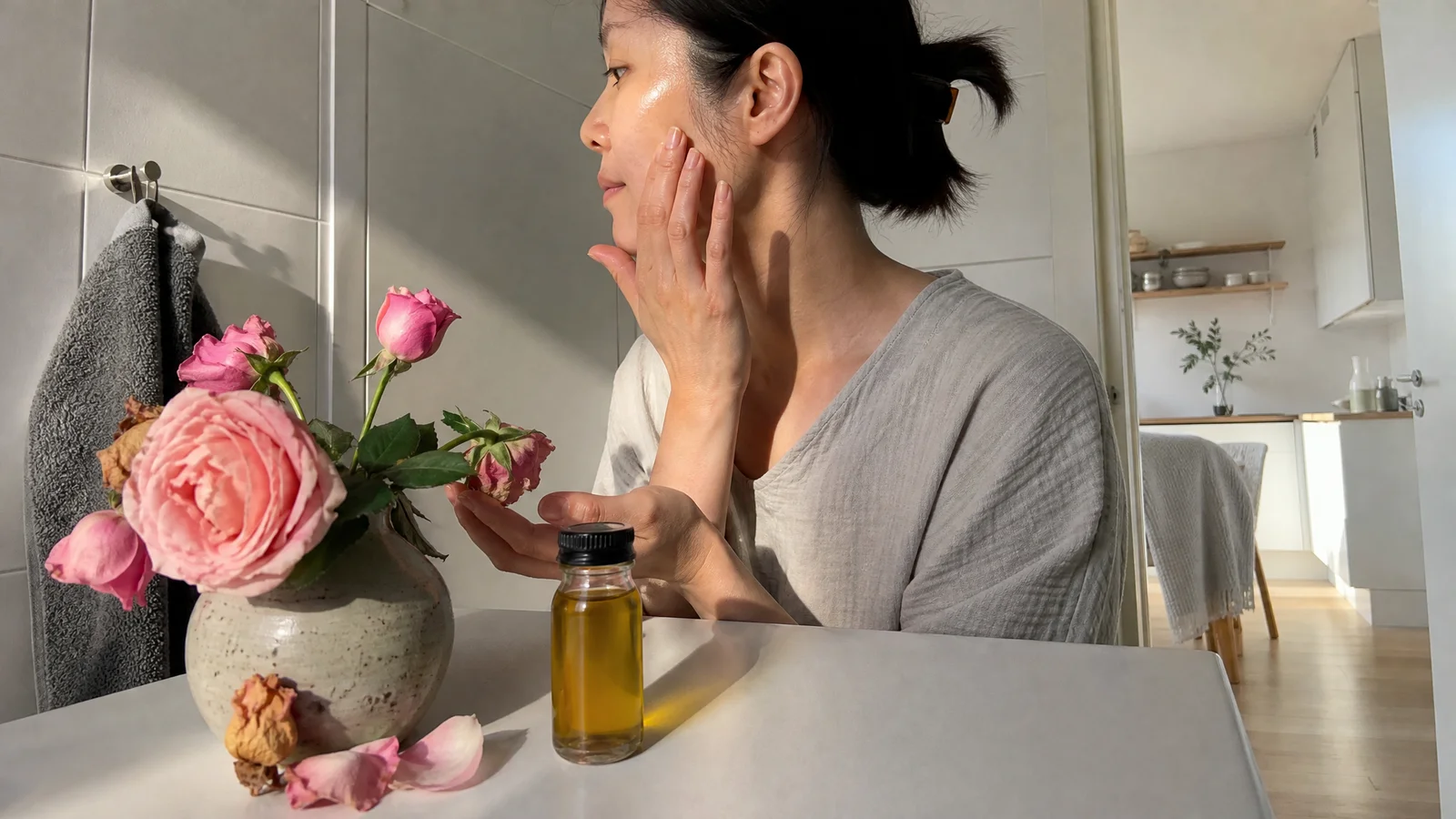
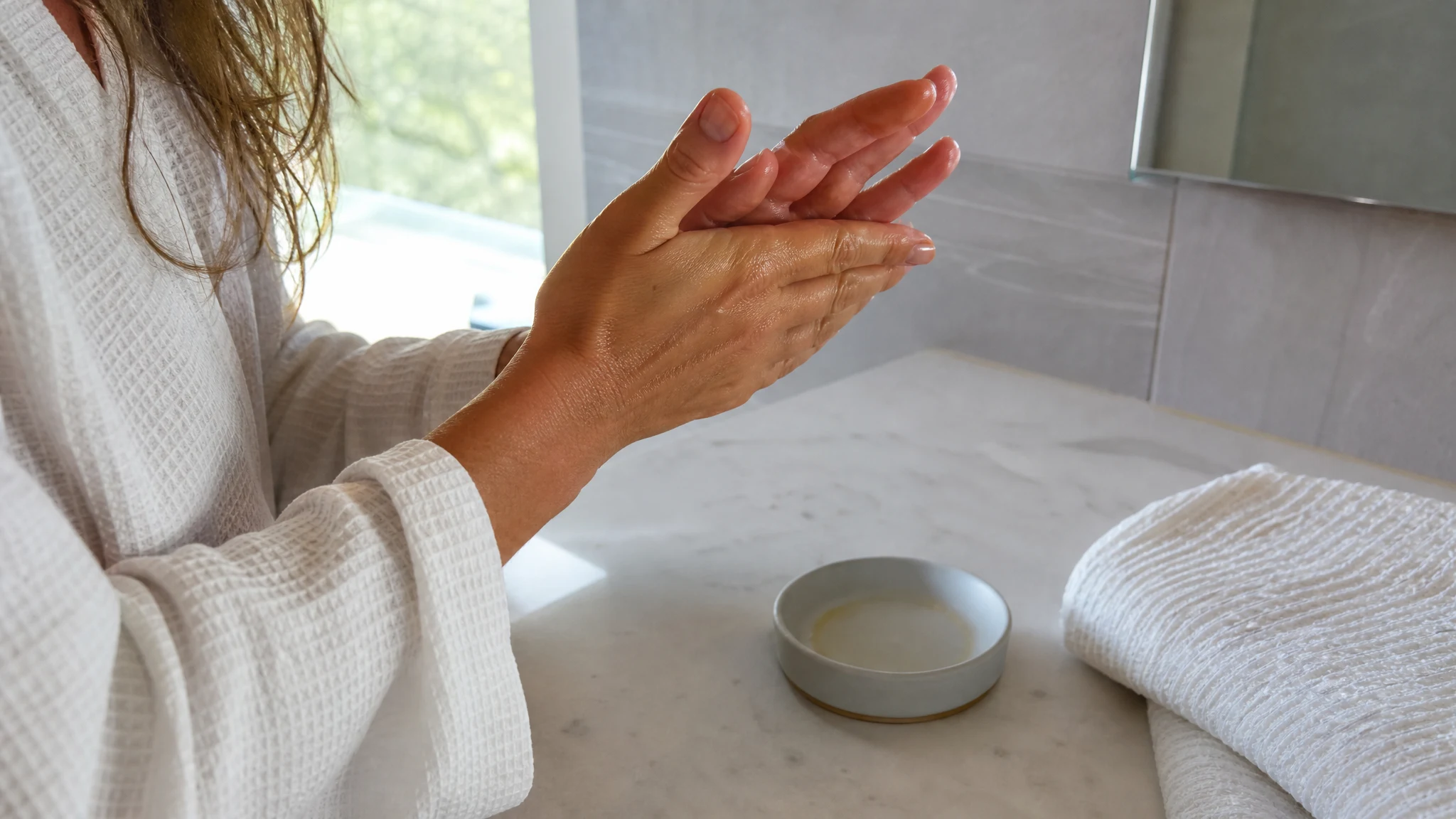
A pre-wash oil is a slow, unhurried thing, and that is half its charm. Warm a little carrier in your palms, work it through the lengths, and notice how the rosy scent rises as the oil warms. It is a small ritual to do before a shower, perhaps while you listen to music or the radio.
Use less than you think you need. You can always add a little more to the ends, but a heavy hand makes the shampoo step a chore. If your hair is fine, a few drops of finished oil may be plenty; thicker hair may want a little more.
The arithmetic in drops
This uses the density on the certificate we publish for one batch (0.888, so 1 ml weighs about 0.888 g) and the rough convention of 20 drops per ml. Droppers vary, so weigh where you can.
| Batch of carrier | At 0.5% | At 0.9%, the most we would use |
|---|---|---|
| 30 ml | about 3 drops | about 5 drops |
| 100 ml | about 10 drops | about 18 drops |
For comparison, 2% in 30 ml would be about 12 drops, which is why the table stops where it does.
Making and using it
- Weigh or measure the carrier into a clean, dry glass bottle, warming it first if it has set.
- Add the palmarosa drops, cap and swirl.
- Work it through the lengths and ends first. The study measured effects on hair, and the scalp is the skin that can react, so keep the scalp optional.
- Leave it for a short time, then shampoo it out. We have no sourced contact time, so start short.
The American Academy of Dermatology suggests shampooing the scalp rather than the full length of the hair to remove built-up product (AAD, healthy hair tips). With no water in the blend, you also avoid several of the contamination routes the FDA lists, though fats still go rancid, so make small batches and store them closed, cool and out of the light (FDA).
Towels, pillowcases and bathrooms
Think of the practical side too. Oiled hair leaves marks, so use an old towel, wear an old T-shirt, and leave the bottle on a stable shelf rather than the edge of the bath. A slippery bathroom floor is no fun, so wipe up any drips straight away.
Patch test first
Dab a little behind the ear and wait 24 hours. A clinic patch test keeps the allergen on the skin for two days across two to three visits (FDA), so a home test is only a first step. Skip the batch at any redness, itching or swelling, and skip the scalp entirely if it is already scaly, red or sore, because the AAD notes that similar-looking scalp problems can be dandruff, psoriasis or scalp ringworm and need a diagnosis (AAD, dry scalp).
This is a scented grooming oil, and we make no claim about hair growth or scalp conditions. Any oil on hair can mark pillowcases and towels, so lay an old towel down. Keep the oil away from eyes, children and pets and never swallow it. Our hair article goes further, and the dilution chart has the wider conversions.
Rose-scented hair after a pre-wash oil is a small luxury, and it costs you a few drops.
Palmarosa Essential Oil
Palmarosa Essential Oil from our own shop, in sizes from 0.5 oz to bulk.
From $10.99
Shop Now →Sources & Further Reading
- Rele AS, Mohile RB, 2003. Effect of mineral oil, sunflower oil, and coconut oil on prevention of hair damage. J Cosmet Sci
- IFRA Standard: Geraniol, 2023 (Amendment 51)
- Annex on contributions from other sources to the IFRA Standards, 51st Amendment
- Guidance for the Use of IFRA Standards, 51st Amendment (June 30, 2023)
- Tisserand Institute, Dilution for essential oils
- Hagvall L et al., 2007. Fragrance compound geraniol forms contact allergens on air exposure. Identification and quantification of oxidation products and effect on skin sensitization. Chem Res Toxicol
- American Academy of Dermatology, Healthy hair tips
- American Academy of Dermatology, Is your dry scalp something more serious?
- FDA, Microbiological Safety and Cosmetics
- FDA, Allergens in Cosmetics