Palmarosa Oil Research: A Tour of What Scientists Study
Palmarosa gets studied a lot. Search the scientific literature and you will find the grass, its oil and its main component, geraniol, in papers on everything from crop yield to cat fleas. It is a fun body of work to browse, and it is easiest to enjoy with one idea in mind: nearly all of it happens in dishes, flasks and cages, not in people.
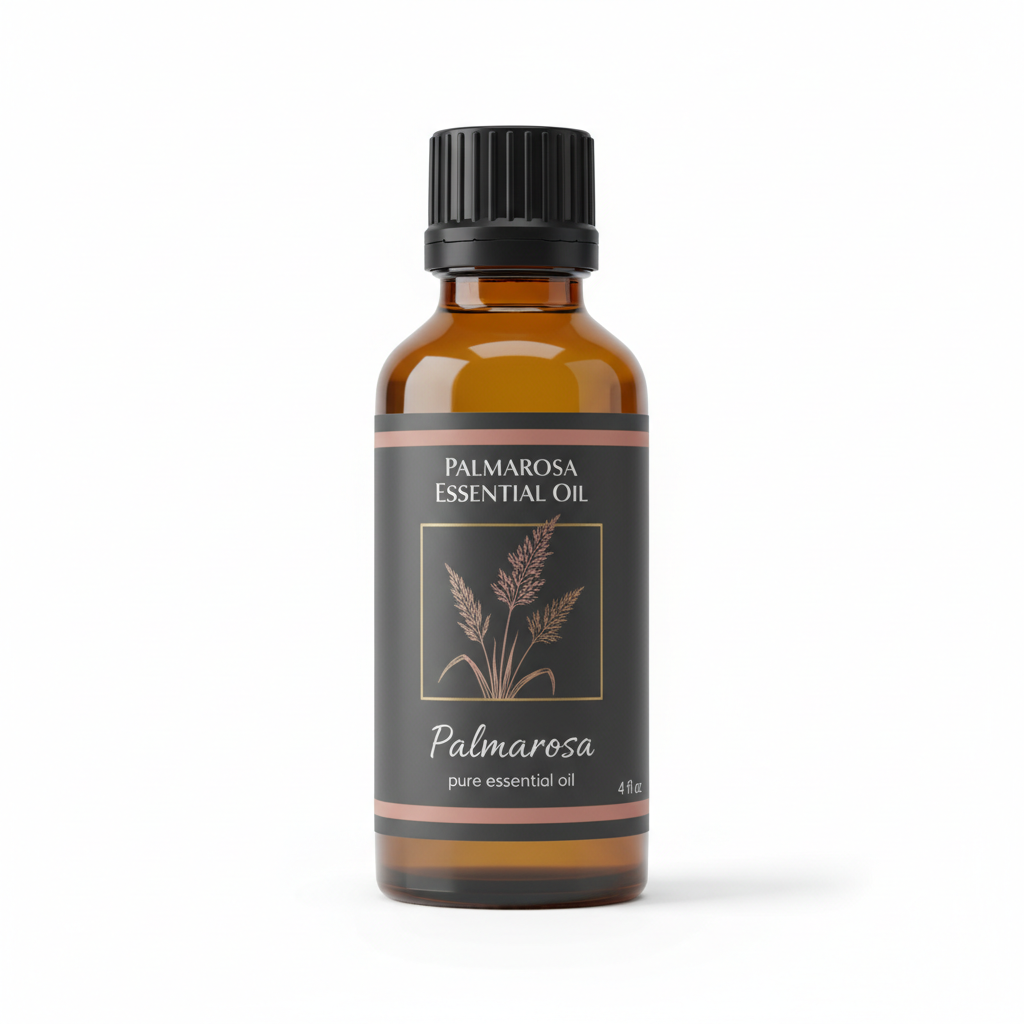
Palmarosa Essential Oil
Our own Palmarosa Essential Oil, in sizes from 0.5 oz to bulk.
From $10.99
Shop Now →Where the work happens
Most studies fall into a handful of neighbourhoods. Chemists describe what is in the oil. Plant scientists ask when to cut the grass. Microbiologists test the oil against organisms in culture. Entomologists test it against insects. In none of them are researchers asking whether a fragrance oil does something for you at home, and that matters for how to read them.
The plant studies are our favourites. A 2025 paper in Frontiers in Plant Science analysed Cymbopogon martinii oil from plants harvested at three growth stages and found 59 compounds in total, with yield and make-up changing as the plant matured (Influence of growth stage on the chemical composition, antimicrobial, and antioxidant potential of Cymbopogon martinii (Roxb.) Wats. essential oil). That one sentence explains why two bottles labelled palmarosa can smell a little different, and we explore the plant itself in our palmarosa plant article.
If you like gardens, you will enjoy the idea that the grass changes as it grows. A tall green stand and one with colouring seed heads are the same plant at different moments, and our How It's Made page describes the grass being cut once the seed heads are colouring. Timing is part of the story of every bottle.
What happened in the dish
A few examples show the range. A 2025 study in Pharmaceutics exposed 17 bacterial isolates from patients to palmarosa oil and to geraniol and recorded the lowest strengths that stopped growth, along with how the oil affected a human liver cell line in culture (Antibacterial Activity of Palmarosa (Cymbopogon martini (Roxb.) Will.Watson) Essential Oil and Geraniol Against Clinical Isolates from Respiratory, Skin, and Soft Tissue Infections). A 2025 paper in Microbial Pathogenesis screened seven oils against microbes associated with dandruff, and reported palmarosa as the most potent of the seven in culture (Palmarosa essential oil inhibits the growth of dandruff-associated microbes by increasing ROS production and modulating the efflux pump). A 2024 Scientific Reports study compared dozens of oils against a yeast in the lab (Antifungal activity of essential oils and their potential synergistic effect with amphotericin B). On the insect side, there is the cat flea paper and a mosquito and tick study of geraniol, both described in our mosquito article.
Researchers are doing exactly what they should with these: finding out what a material can do under controlled conditions. The strengths they use are the first thing to notice. A culture broth can be dosed at a level that would be far above any sensible skin dilution, and a filter paper has none of the barrier, oils, movement or immune response of real skin. In other words, a result tells you where scientists might look next, not what to expect from a bottle. A study of geraniol is also a study of one molecule rather than a whole oil, so even the neighbouring material is not the same thing.
What the studies do not say
Look at what the authors measured and what they claim, and you will find careful language. They talk about activity against organisms in culture and call for more research. We try to do the same. We do not take any of these results as a promise about our oil, and the Certificate of Analysis we publish for one batch lists density, refractive index and optical rotation rather than a constituent breakdown. If you need GC-MS data for your own formulation, ask us in writing through the contact page before ordering.
The FDA decides whether a product is a cosmetic or a drug by how it is promoted, and gives the example that a fragrance sold for attractiveness is a cosmetic while an oil sold to help people sleep is a drug (Is It a Cosmetic, a Drug, or Both? (Or Is It Soap?)). That is why we describe our palmarosa as a fragrance and cosmetic ingredient, and why we present these studies as science worth reading, not as claims. If you have a health or skin concern, a pharmacist, GP or dermatologist is the person to ask.
A reading list for the curious
Start with the plant paper, then the chemistry, then the dish studies. Read the abstract first, then jump to the methods and see what amounts were used and what the oil was tested against. You will quickly learn to spot which results are about the plant, which are about a molecule and which are about the whole oil.
How to enjoy the science
We think the best use of this research is curiosity. It tells a story about a grass that grows tall and smells like rose, whose oil is rich in geraniol, and which chemists across the world find worth examining. Pair it with our explainers on geraniol and the chemistry of a rose and how palmarosa oil is made, and you have a pretty complete picture of where the scent comes from.
Put a drop of the oil on a paper strip and read a page while you wait for the scent to change. It turns a dry paper into something you can smell, and the sweet, rosy, gently green character shifts nicely as the minutes pass.
Then put the oil to work where it shines, in a diffuser, a perfume blend or a diluted body oil, and let the scientists keep exploring.
Palmarosa Essential Oil
Palmarosa Essential Oil from our own shop, in sizes from 0.5 oz to bulk.
From $10.99
Shop Now →Sources & Further Reading
- Influence of growth stage on the chemical composition, antimicrobial, and antioxidant potential of Cymbopogon martinii (Roxb.) Wats. essential oil, Sonigra and Meena, Front Plant Sci, 2025
- Antibacterial Activity of Palmarosa (Cymbopogon martini (Roxb.) Will.Watson) Essential Oil and Geraniol Against Clinical Isolates from Respiratory, Skin, and Soft Tissue Infections, Pharmaceutics, 2025
- Palmarosa essential oil inhibits the growth of dandruff-associated microbes by increasing ROS production and modulating the efflux pump, Microb Pathog, 2025
- Antifungal activity of essential oils and their potential synergistic effect with amphotericin B, Sci Rep, 2024
- Is It a Cosmetic, a Drug, or Both? (Or Is It Soap?), FDA