What Is Palmarosa? The Tall Grass Behind the Rose Scent
Nobody expects a rose scent to come from a grass. Palmarosa is a tall, tufted, fragrant grass whose leaves, when crushed, smell sweetly of rose with a green edge, and the oil steam-distilled from it is one of the most pleasant surprises in a perfumer's cupboard. Here is the plant behind the bottle.
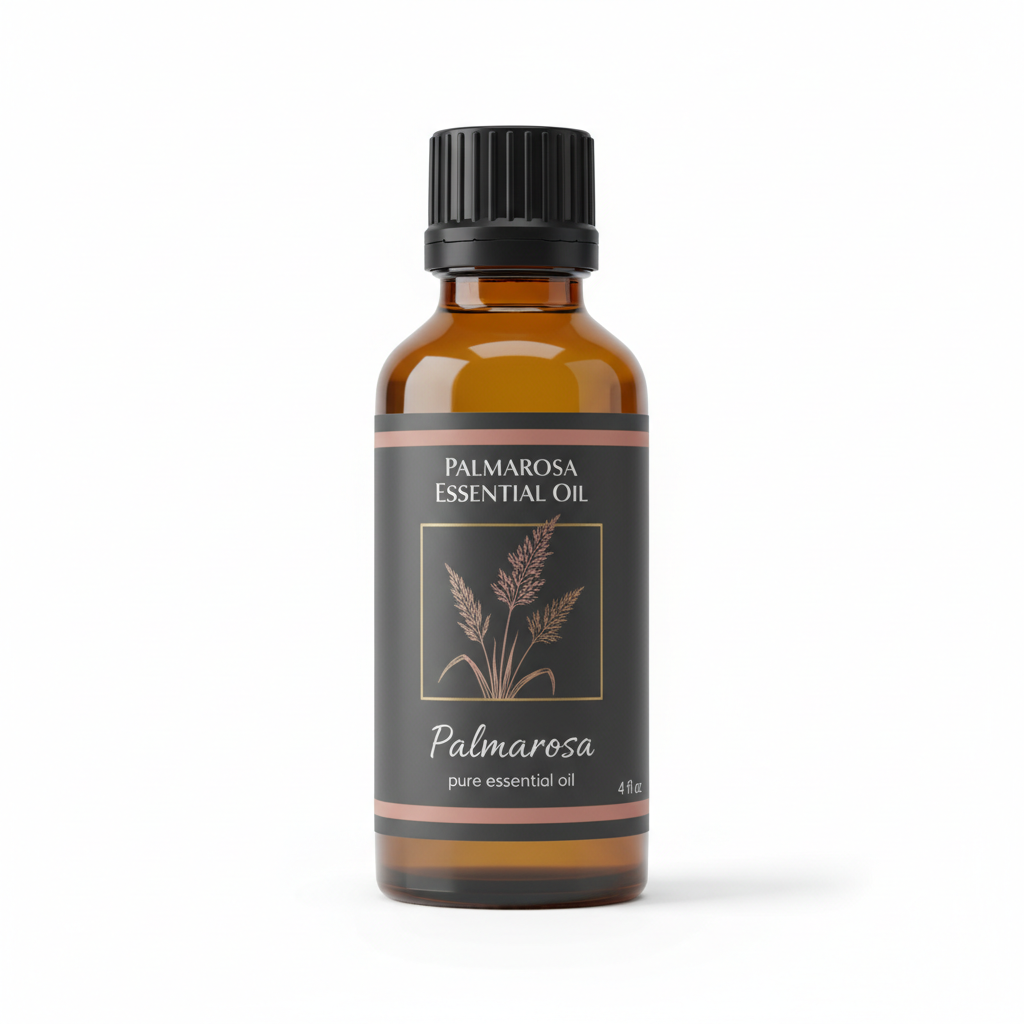
Palmarosa Essential Oil
Our own Palmarosa Essential Oil, in sizes from 0.5 oz to bulk.
From $10.99
Shop Now →A grass with a name problem
The plant's botanical name is spelled two ways. The International Plant Names Index records the accepted combination as Cymbopogon martini (Roxb.) Will.Watson, in the grass family Poaceae (IPNI name record for Cymbopogon martini), while many labels, including the Certificate of Analysis we publish, use the double-i spelling martinii. They refer to the same plant in everyday trade. It sits in the same genus as lemongrass and citronella, though palmarosa's chemistry runs high in geraniol rather than citral.
What it looks like and what it likes
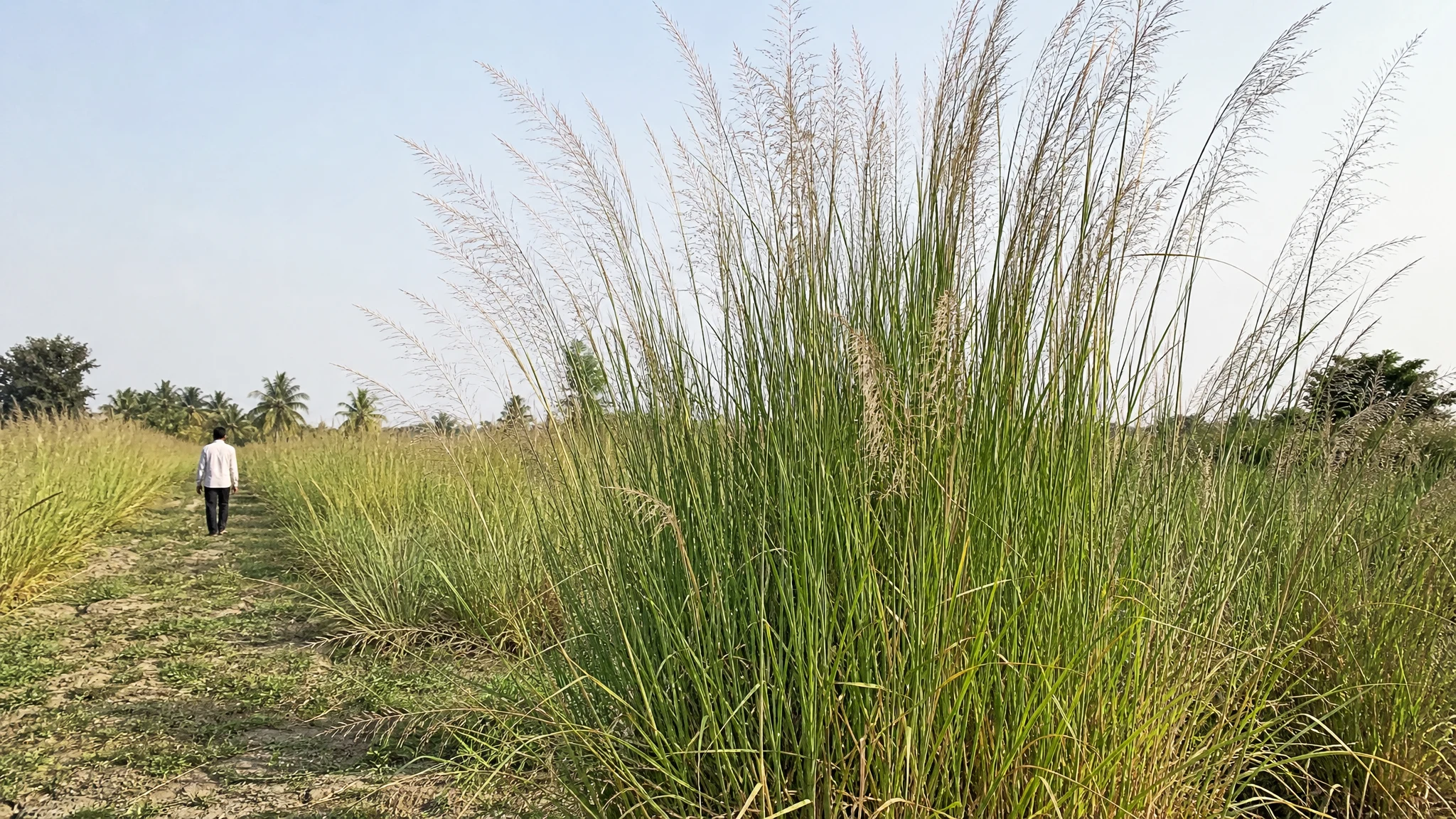
The plant handbook PROSEA describes a perennial tufted grass growing from a short woody rhizome, with stems up to 2 m tall and sometimes 3 m, leaf blades up to about 50 cm long and 3 cm wide, and a narrow flowering head that turns bright red as it fruits (Cymbopogon martini (Roxb.) J.F. Watson). It is a plant of warm, fairly dry country. PROSEA gives about 150 to 800 m of altitude, roughly 750 mm of rain a year for one harvest, and average daily temperatures of 20 to 25 C as ideal, adding that frost damages the plant at every stage. Leaves are the part we use, which matches the Parts Used line on our Certificate of Analysis.
Why the cutting date matters
This is the part we find most fun. According to PROSEA, the oil content of the plant peaks after the flowers open and falls sharply once flowering is over, so harvest is timed to the flowering stage. We think of it the same way: the grass is best cut once the seed heads are colouring, when the geraniol content is at its highest, whereas grass cut green and early gives a fraction of the oil and a sharper aroma. After cutting, PROSEA says the crop is left in the field for a few hours to wilt, and can then rest in a cool shady place for several days without much loss.
A 2025 study in Frontiers in Plant Science adds a twist. It distilled oil from Cymbopogon martinii at vegetative, reproductive and post-reproductive stages and found the composition changed from stage to stage, with a different set of leading compounds from the geraniol-led oils described elsewhere (Influence of growth stage on the chemical composition, antimicrobial, and antioxidant potential of Cymbopogon martinii (Roxb.) Wats. essential oil). The takeaway is that a plant name is a starting point, and growth stage and plant type shape the scent. That is why reading a palmarosa label is a skill worth learning.
If you ever meet the plant
If you get the chance to rub a palmarosa leaf between your fingers, do it. A crushed blade gives off a bright, sweet, rosy smell with plenty of fresh green in it, quite different from the more finished, mellow aroma in a bottle. It is a good way to understand why a grass has been valued by perfumers for so long.
It is also a good reminder that the bottle is a concentrate of something very ordinary-looking. Tall, tufted, unfussy leaves that you could mistake for lemongrass at a glance carry all of that rosy scent. We find that rather charming.
How much oil is one plant?
PROSEA says a well-managed crop in India gives 50 to 100 kg of oil per hectare per year. At the 80 to 90 cm square spacing it gives for small farms, a hectare holds roughly 12,000 to 15,600 plants, so by our arithmetic each plant yields about 3 to 8 g of oil in a year. A 0.5 oz bottle holds 14.8 ml, which at the density of 0.888 on the batch in our Certificate of Analysis is about 13 g. So a single half-ounce bottle represents a good share of a few plants' whole year of growth. The same handbook notes that traditional stills recover only 0.2 to 0.3% of the fresh grass by weight, which means a few kilograms of grass for 13 g of oil. This is reasoning from the handbook's figures, not a measurement of any farm, but it paints the picture: a garden clump is a handsome plant, and a bottle is a lot of grass.
A tip for anyone who loves a scent: take a moment to smell the bottle before you decide what to make with it. Knowing the plant behind the smell changes how you use it, with more patience and a lighter hand.
From grass to the bottle
Palmarosa is a steam-distilled oil, with steam passed through the cut grass until the oil is carried over, which is how the batch on our Certificate of Analysis is described. We go through the process in how palmarosa oil is made, the chemistry in inside palmarosa oil, and the overview in what palmarosa essential oil is. If you would like to read about a particular lot, ask us in writing through the contact page.
The next time you smell palmarosa, picture a waving stand of tall grass, a few hours of wilting in the sun, and a lot of leaves for one small bottle. It makes the scent feel earned.
Palmarosa Essential Oil
Palmarosa Essential Oil from our own shop, in sizes from 0.5 oz to bulk.
From $10.99
Shop Now →Sources & Further Reading
- IPNI name record for Cymbopogon martini, International Plant Names Index
- Cymbopogon martini (Roxb.) J.F. Watson, PROSEA Plant Resources of South-East Asia
- Influence of growth stage on the chemical composition, antimicrobial, and antioxidant potential of Cymbopogon martinii (Roxb.) Wats. essential oil, Sonigra and Meena, Front Plant Sci, 2025