How to Read a Palmarosa Label: Motia, Sofia, Origin
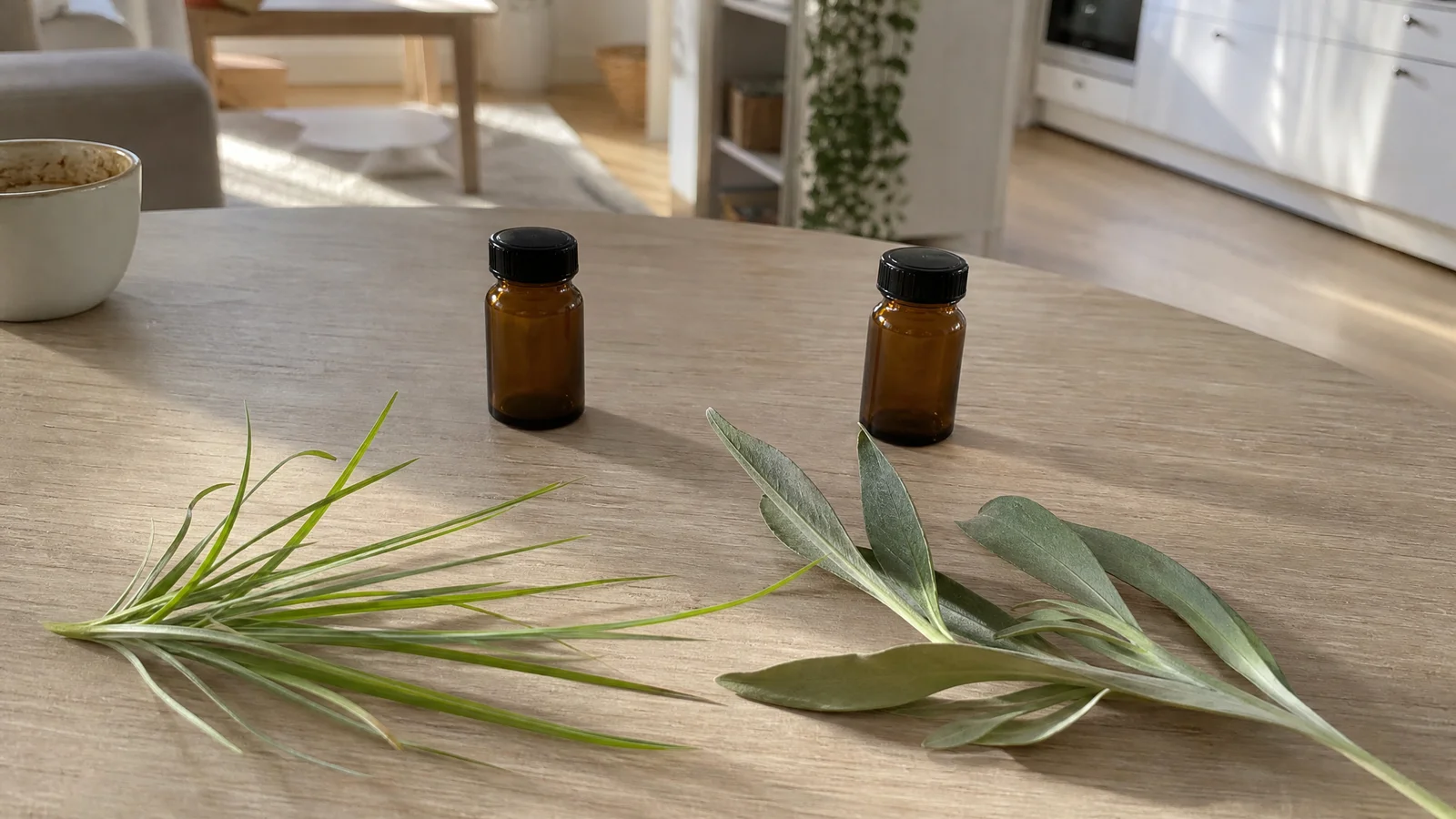
Two very different oils are sold under the Latin name Cymbopogon martinii. One is rich in geraniol and smells of rose. The other is listed by the fragrance industry as a separate material with almost no geraniol in it. Once you know that, a palmarosa label stops being a formality and becomes a small puzzle worth solving, and the pieces are easy to read.
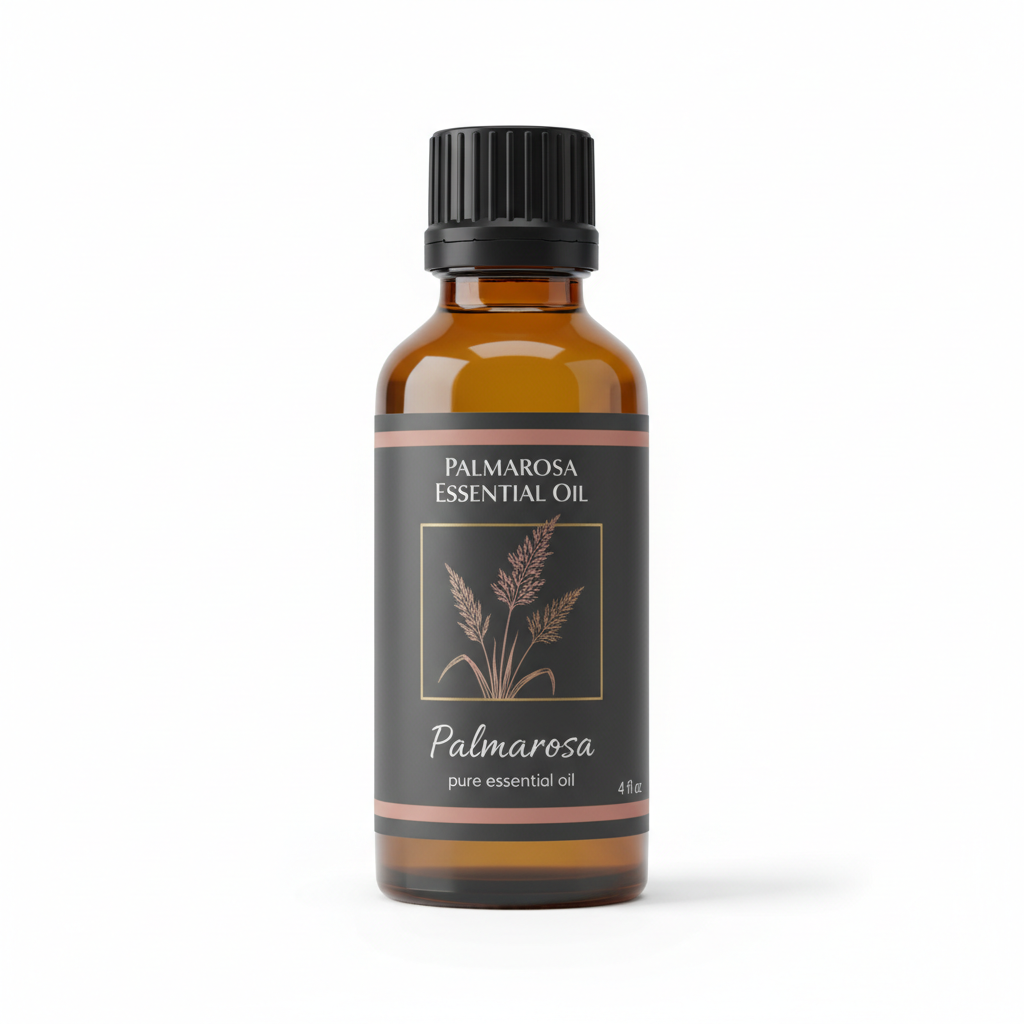
Palmarosa Essential Oil
Our own Palmarosa Essential Oil, in sizes from 0.5 oz to bulk.
From $10.99
Shop Now →One name, two entries
IFRA, the fragrance industry's self-regulatory body, keeps an annex of typical natural compositions. In its 51st Amendment, "palmarosa oil" (Cymbopogon martinii, CAS 8014-19-5) has geraniol at 82.4%. A separate entry, "gingergrass oil" (C. martinii var. sofia, CAS 8023-92-5), has geraniol at 0.04% and carvone at 4%. A 2025 paper on wild-growing C. martinii from Rajasthan found no geraniol among its principal constituents and said the profile resembled var. sofia, in contrast to the geraniol-dominant var. motia. Notice what the authors left unsaid: they did not declare which variety their plant was, only what the result resembled. That caution is a good model for reading labels, because "motia" or "sofia" printed on a bottle is a claim that only a composition report can back up.
Reading the label line by line
| Label line | What it tells you | What it leaves open |
|---|---|---|
| Botanical name | The species the seller says it is | Which type of oil; spellings also vary (martini and martinii both appear), so a variant spelling is not a red flag |
| Variety (motia or sofia) | A claim you can test with a GC report | Nothing, unless a composition table supports it |
| CAS number | Which IFRA entry the seller maps the oil to | Authenticity; a number is printed, not measured |
| Part used | Leaf or other plant part | Quality on its own |
| Origin | Where the seller says the grass grew | Whether a document backs it |
| Ingredient line | Whether the bottle is the oil alone | Strength or composition |
Part used earns a closer look. In a Nepalese study of cultivated C. martini, leaf oil was 76.6% geraniol and 15.2% geranyl acetate, while root oil from the same plants was 87.9% geraniol and 4.4% geranyl acetate. A label that says only "palmarosa" leaves that variation unexplained, and the geraniol figure feeds straight into safety arithmetic, since IFRA limits geraniol by product category.
The ingredient line
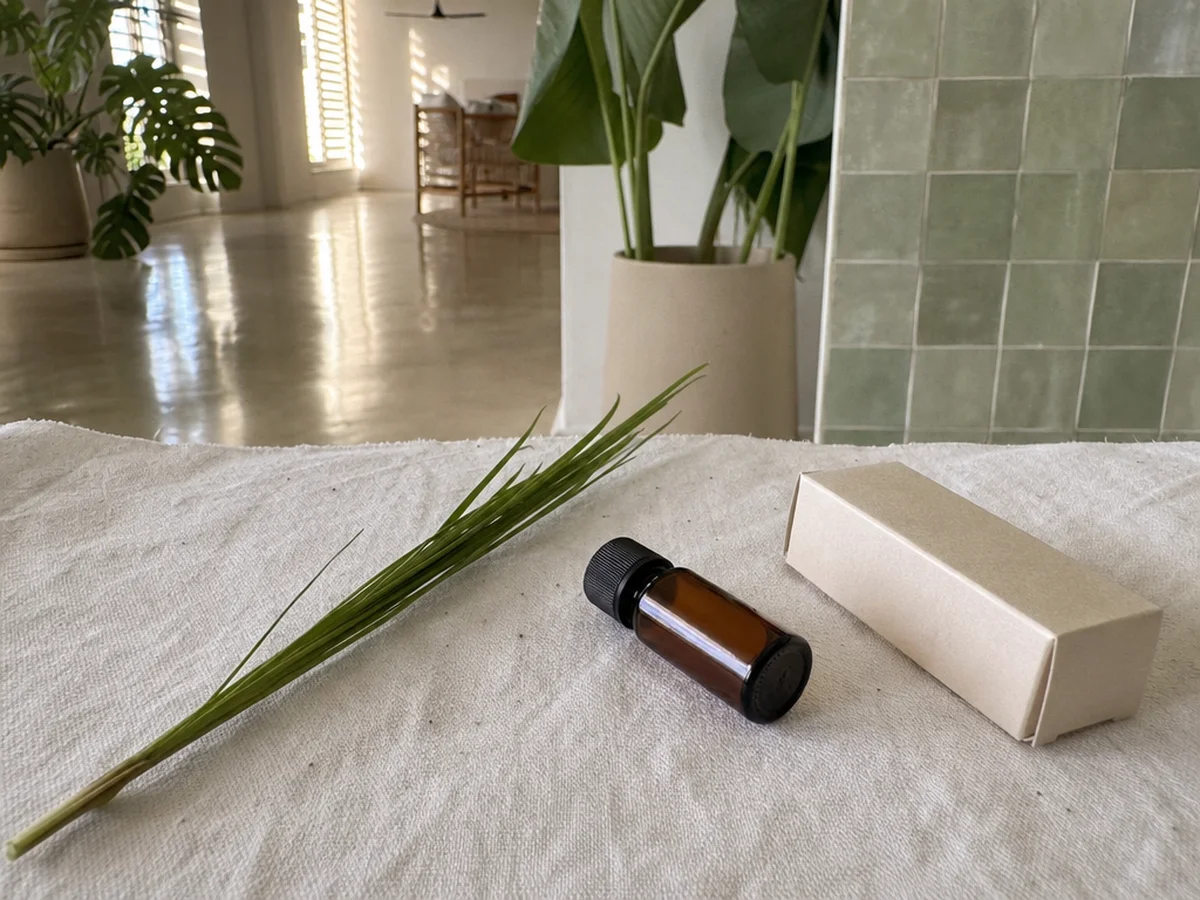
A US cosmetic label lists ingredients in descending order of predominance, and the rule lets "fragrance" stand in for fragrance materials without naming them. That is why a single-ingredient bottle is so easy to read: one line, one oil. The Certificate of Analysis we publish for one batch uses the form "Cymbopogon martinii (Palmarosa) Leaf Oil", with leaves as the part used, steam distillation as the method and CAS 8014-19-5, which matches IFRA's palmarosa entry rather than the gingergrass one. A number on a certificate is a statement and not an analysis, so we do not lean on it as proof. If a listing shows a carrier first, it is a diluted product, and our price comparison guide shows how to adjust the sums.
Origin, organic and grade words
A country on a label might describe where the grass grew, where it was distilled or only where it was bottled. Unless a document names the country and the grower or distiller, read it as a sales description. Our certificate names no origin, so if you need one, ask us in writing through the contact page and rely only on a document supplied for your lot. "Organic" needs a certifier and certificate number you can look up, and our organic label guide covers the US rules. Words such as "premium" or "grade" have no shared definition, so treat them as invitations to ask for numbers.
Keep your own notes
If you buy oils regularly, a simple notebook helps. Write down the botanical name, the part used, the date and what you thought of the smell. After a few bottles you'll have your own reference, and labels will start to make sense much faster.
Why we care about the geraniol line
Geraniol is the component IFRA restricts. Our general dilution guidance is 0.5% to 2% in a carrier oil with a patch test first, and for a facial product IFRA's 0.78% geraniol limit works out, at the 82.4% typical figure, to about 0.95% oil. That is our arithmetic, not a measurement of our oil, and it is why we start at 0.5% for the face. An oil with less geraniol shifts the sum, which is one more reason the composition line matters. The dilution chart has the full table.
Use your nose as well as the label
Paper is only half the story. When a bottle arrives, open it and smell it before you read anything else. A rose-leaning oil smells sweet, floral and green; if what you meet is sharp, harsh or oddly turpentine-like, that is worth noting and worth asking about. Your nose won't replace a composition report, but it is a quick first check and a pleasant habit.
Smell it again on a blotter after ten minutes. You'll notice how the aroma develops from the first sniff, which tells you more about the oil than a single quick whiff.
A quick routine for the next bottle
- Find the botanical name, the part used and the CAS number.
- Check the CAS number against the two IFRA entries above.
- Ask for the GC-MS report for your lot, with the laboratory named.
- Treat organic and grade wording as claims to verify.
Our quality checks guide lists what a good report shows. Ask the same questions of every seller, us included, and the label becomes a conversation you can enjoy.
Palmarosa Essential Oil
Palmarosa Essential Oil from our own shop, in sizes from 0.5 oz to bulk.
From $10.99
Shop Now →Sources & Further Reading
- IFRA, 2023. Annex on contributions from other sources to the IFRA Standards (51st Amendment)
- IFRA, 2023. IFRA Standard: Geraniol, 2023 (Amendment 51)
- Sonigra P, Meena M, 2025. Influence of growth stage on the chemical composition, antimicrobial, and antioxidant potential of Cymbopogon martinii (Roxb.) Wats. essential oil. Frontiers in Plant Science
- Dangol S et al., 2023. Essential Oil Composition Analysis of Cymbopogon Species from Eastern Nepal by GC-MS and Chiral GC-MS, and Antimicrobial Activity of Some Major Compounds. Molecules
- Legal Information Institute, 21 CFR 701.3 - Designation of ingredients