Palmarosa Oil Antifungal Studies: Dish Versus Foot
Search for palmarosa and fungi and you will find real papers with real results: in a lab dish, palmarosa oil slows the growth of several fungi. It is a fascinating bit of chemistry. It is also a long way from a foot, which is why we like to read these studies carefully and why we do not offer our oil for any skin or nail infection. We sell it as a fragrance material, with a rosy aroma and a dilution guide.
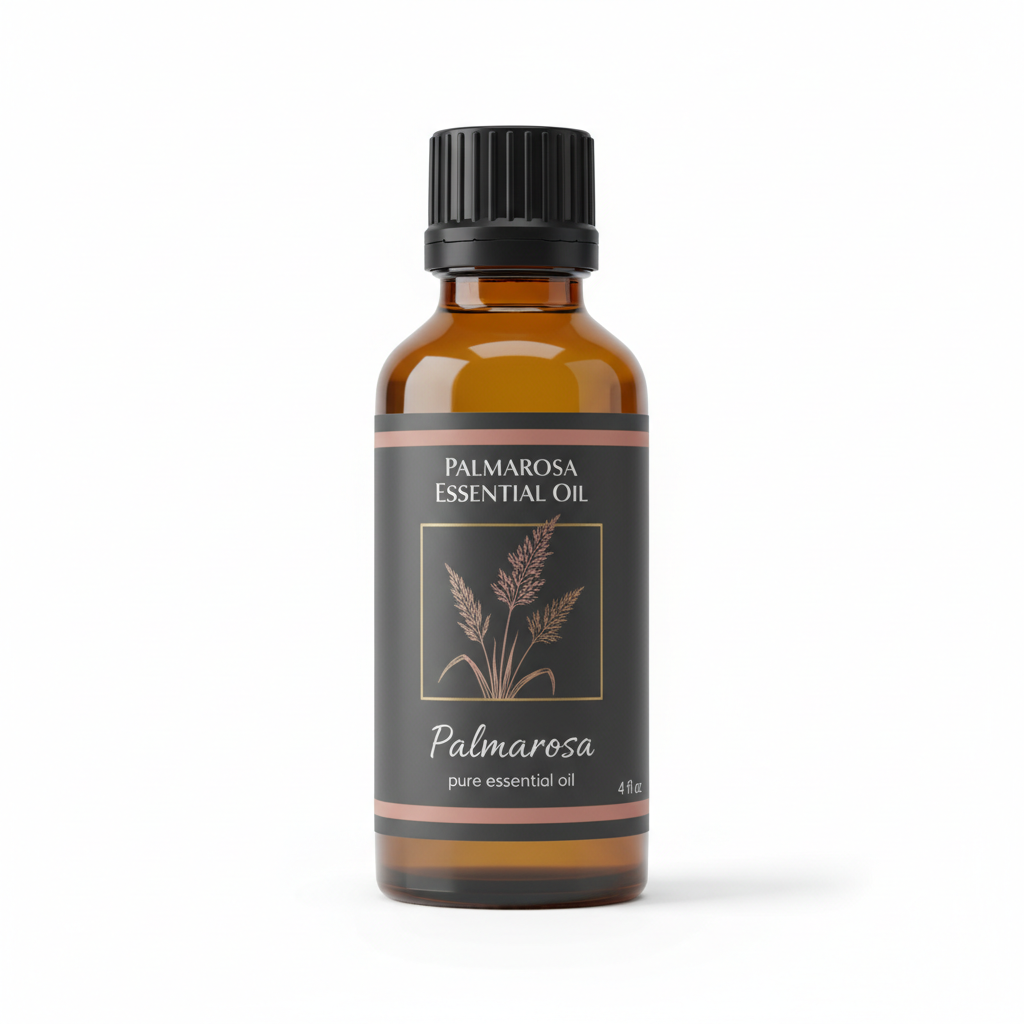
Palmarosa Essential Oil
Our own Palmarosa Essential Oil, in sizes from 0.5 oz to bulk.
From $10.99
Shop Now →What the dish studies found
In 2024, a team screened 98 essential oils against Candida albicans, a yeast. Forty-eight showed activity at a 1% concentration, and palmarosa was one of five that stood out, with geraniol and geranyl acetate as its main components. Mixed with the antifungal drug amphotericin B, it also showed a synergistic effect against growing cells. Another 2024 paper tested neem extract with two oils, eucalyptus citriodora and Cymbopogon martini (palmarosa), against two fungi that cause scalp ringworm, and reported that the oils inhibited growth at 0.625 to 2.5 microlitres per millilitre.
These are good reasons for scientists to keep going. They are not instructions for anyone at home, and the second paper shows why. Take the lowest figure, 0.625 microlitres per millilitre. Using the density of the batch on our Certificate of Analysis, 0.888, as a stand-in, that works out to about 555 micrograms per millilitre. The comparison drug in the same study, fluconazole, worked at 0.25 and 0.50 micrograms per millilitre. By weight, the oil needed concentrations roughly a thousand times higher or more (that is our arithmetic, and the oil was tested in a broth where fungus and oil are mixed together). Concentrations like that in a test tube are easy. Delivering them through skin or a nail is another matter entirely.
A dish is not a foot
Skin is layered, nails are dense, and a rash that looks like a fungal infection is sometimes something else. That last point is why the first step is to know what you have. The NHS says athlete's foot is unlikely to get better on its own, that a pharmacist can sell you antifungal creams, sprays or powders, and that they usually take a few weeks to work. It advises seeing a GP if pharmacy treatments have not worked, if the foot is hot, painful and red, if the infection spreads to other parts of the body, or if you have diabetes or a weakened immune system.
A pharmacist is also the best person to ask about a thickened nail, a ring-shaped patch or an itchy scalp. A scented oil rubbed onto an undiagnosed rash adds a fragrance allergen to a situation that has not been named, and fragrance allergy can itself look like a rash. Our post on sensitive skin and fragrance explains that side.
If you read studies for fun, here is a habit we like: write down three things for every result, the material, the amount and the setting. When one of the three is "a dish", "a broth" or "filter paper", you know the finding belongs to the laboratory for now. It takes a minute, and it makes product pages far easier to read.
Questions worth asking any page that quotes a study
Does it name the oil, the plant and the amount? A page that says "studies show" with nothing behind it is not telling you anything you can use. A good page points to the paper, says what it tested, and stops there. We try to do the same here.
Why we describe it by scent
The FDA decides whether a product is a cosmetic or a drug partly by its intended use, and it treats what a seller says on labels, advertising and websites as evidence of that intent. Our palmarosa is a fragrance oil. We describe it as sweet, rosy and gently green, and we leave treatment of any condition to doctors and pharmacists. The Certificate of Analysis we publish for one batch lists density, refractive index and optical rotation; it is a record of those physical properties, not of anything a lab dish might show.
What to enjoy palmarosa for
Palmarosa belongs in soap, candles, perfume and home fragrance. It is a bright, rosy middle note that costs less than rose and is easier to pair than you would expect. If you are curious about the broader research, our research roundup collects what has been studied, and our comparison with tea tree oil sets two very different oils side by side. For skin use of any kind, the numbers in our dilution chart apply: a carrier, a low percentage and a patch test.
Open the bottle and you'll notice why perfumers like it: sweet, rosy and gently green, with a soft lemony hint. It is a light yellow liquid with a viscosity close to water, so it pours cleanly and a drop lands where you aim it. In a candle or a bar of soap, the easy way to find the right amount is to smell the batch as you go and stop when it is pleasant, not when it is loud.
Lab results are exciting because they show where questions are worth asking. Answering them for your own feet takes a pharmacist.
Enjoy the rosy aroma, enjoy the reading, and take the feet to a professional.
Palmarosa Essential Oil
Palmarosa Essential Oil from our own shop, in sizes from 0.5 oz to bulk.
From $10.99
Shop Now →Sources & Further Reading
- Antifungal activity of essential oils and their potential synergistic effect with amphotericin B.
- Antifungal Activity of Neem Leaf Extract With Eucalyptus citriodora Oil and Cymbopogon martini Oil Against Tinea Capitis: An In-Vitro Evaluation.
- Athlete's foot - NHS
- Is It a Cosmetic, a Drug, or Both? (Or Is It Soap?) | FDA