How to Blend Palmarosa Oil: Proportions That Work
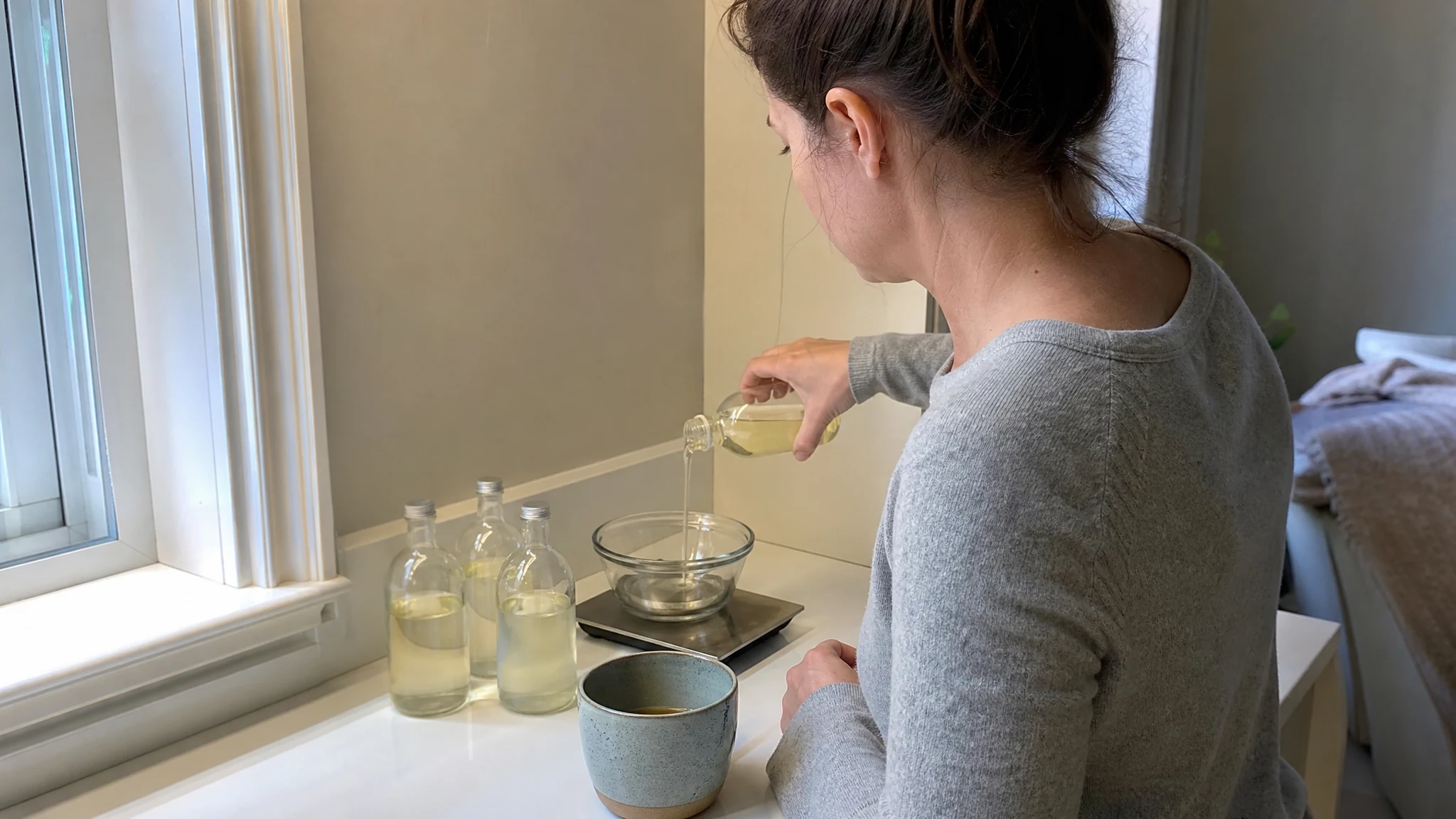
Palmarosa has a way of taking over. It is sweet, rosy and gently green, and its rosiness is strong enough that a heavy hand will dominate a blend. Blending it well is mostly a matter of measuring in parts, then counting the percent for the whole bottle, then checking the sum on the one ingredient that matters for skin.
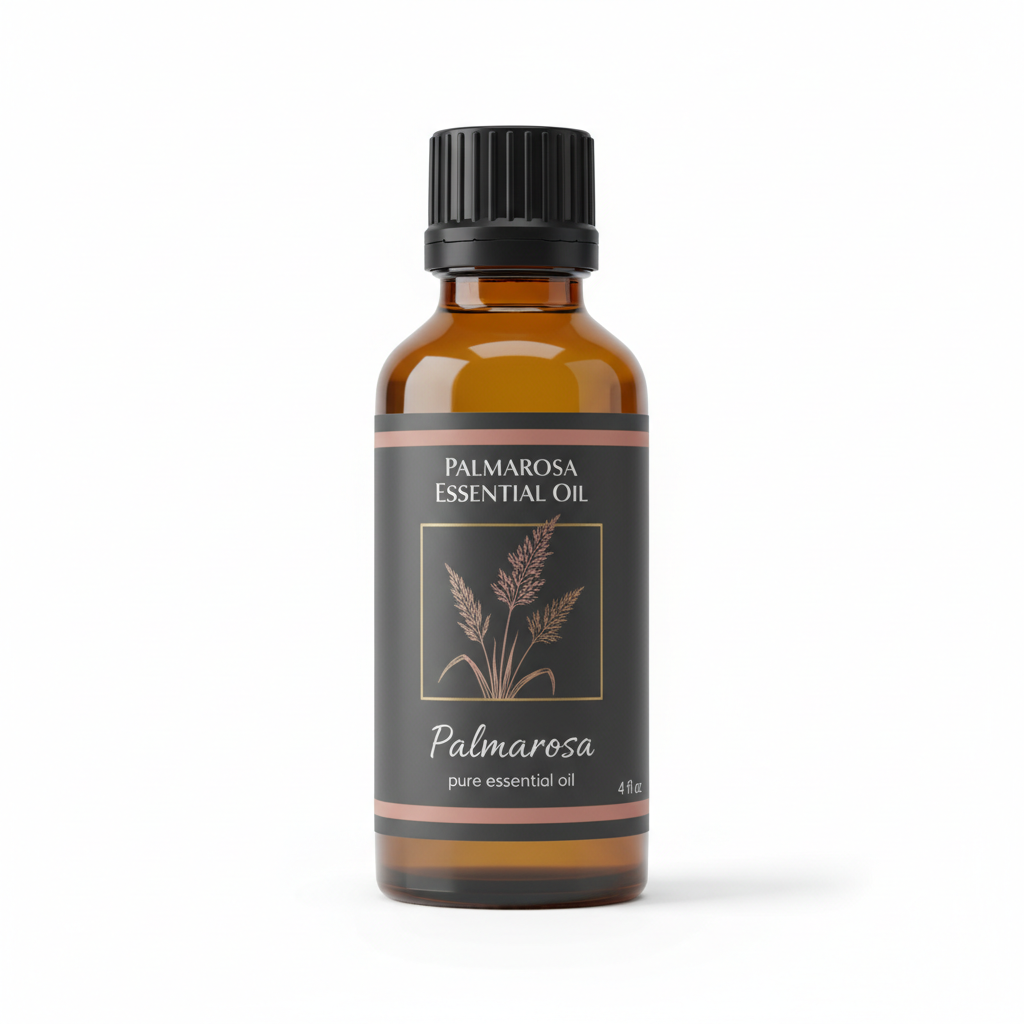
Palmarosa Essential Oil
Our own Palmarosa Essential Oil, in sizes from 0.5 oz to bulk.
From $10.99
Shop Now →Start by deciding what palmarosa is doing
We class palmarosa as a middle note, and the partners we suggest are geranium, bergamot, ylang ylang, sandalwood, lavender and patchouli. That tells you the job: it is the heart of a blend, not the crown or the anchor. A lighter citrus or lavender lifts it. A deeper wood or patchouli grounds it. Our longer pairing article, what blends with palmarosa oil, goes through partners one at a time. None of those partner oils are ours; you will find them at a craft or aromatherapy supply shop.
Think in parts, then convert to percent
Pick a ratio by drops, with the loudest oil the smallest share. A simple frame is 3 parts palmarosa, 2 parts a supporting floral, and 1 part something light or deep to finish. Then decide the total percent of the whole blend in carrier oil, not a percent per oil. This is where most blends go wrong: three oils at 1% each is a 3% blend, not a 1% blend.
The Tisserand Institute makes the same point about drops: conversion rates that use drops are always approximate, because no two drops of essential oil are the same. A 30 ml bottle at roughly 20 drops per ml holds about 600 drops of liquid, so 1% oil is about 6 drops in total. That is a rough convention, and a scale that reads to 0.01 g is better if you plan to repeat the blend.
A worked example for 30 ml of carrier
For a body oil at 1% total: 3 drops palmarosa, 2 drops geranium, 1 drop lavender, into 30 ml of a carrier oil from a craft supply shop. That is a suggestion built from arithmetic, not a house recipe. We suggest jojoba or sweet almond as a carrier, but any you tolerate will do.
The tally that matters: geraniol
Palmarosa is high in geraniol, which IFRA regulates as a fragrance allergen. IFRA's annex gives typical figures of 82.4% geraniol in palmarosa oil, 17.7% in geranium and 0.48% in lavender. Weighting the example above by drops (and treating drops as equal in weight, which is only approximately true):
(3 x 82.4 + 2 x 17.7 + 1 x 0.48) / 6 = about 47% geraniol in the oil mixture. At 1% oil in the bottle, that is roughly 0.47% geraniol in the finished product.
IFRA's geraniol standard caps geraniol at 0.78% in facial moisturiser, 1.2% in body creams, oils and lotions, and 1.1% in products applied to the face with the fingertips. So 1% passes all three. Double the dose to 2% total, and the same blend gives about 0.94% geraniol: fine for a body oil, over the cap for a facial moisturiser. These are our calculations from typical values, not a measurement of any one bottle. For your own formula, check the IFRA standards for the product type. Our line is 0.5% to 2% in a carrier. We start toward the lower end, and lower again for the face, since a cap can be lower than the top of that range.
Four common mistakes
- Counting per oil. Add up all the oils before you compare against a percentage.
- Judging by the bottle. The scent in a bottle is far stronger than on skin or in a room. Smell the blend a few minutes after mixing, not straight from the neck.
- Adding more after the fact. It is easy to add and impossible to subtract. Make a small batch first.
- Using bergamot casually. A cold-pressed bergamot can be phototoxic. Tisserand puts the maximum for sun-exposed skin at 0.4% in the finished product, and notes that bergamot FCF is non-phototoxic.
When you are ready for a specific formula, our pages on dilution by the ounce and roller blends carry the numbers. Patch test any new blend first, as described in our patch test guide.
A good blend is usually one oil you can still identify, with two others steadying it. If you can pick out the palmarosa, you have probably measured well.
Palmarosa Essential Oil
Palmarosa Essential Oil from our own shop, in sizes from 0.5 oz to bulk.
From $10.99
Shop Now →