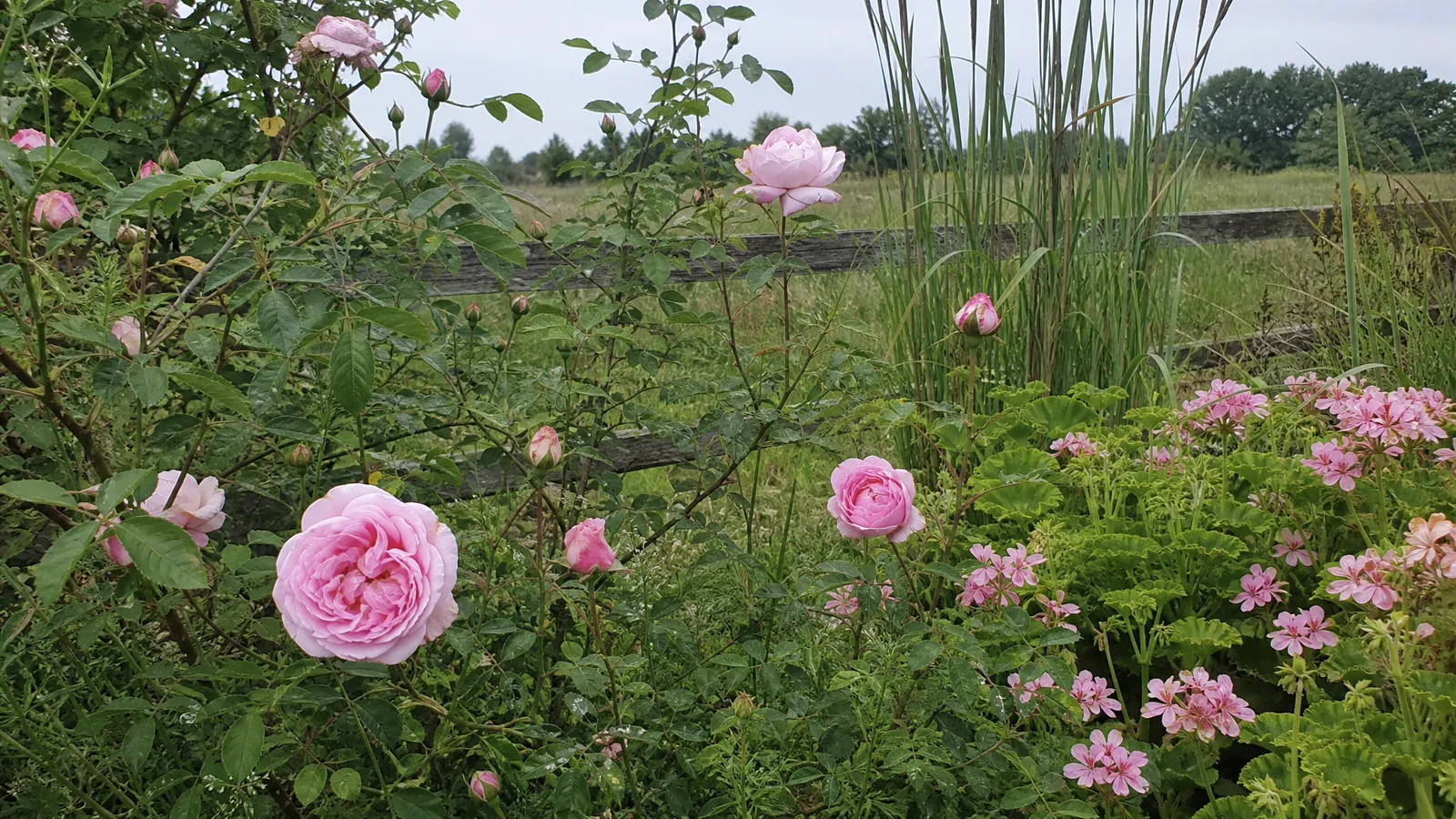
Rose Meadow Blend: Palmarosa, Geranium and Bergamot
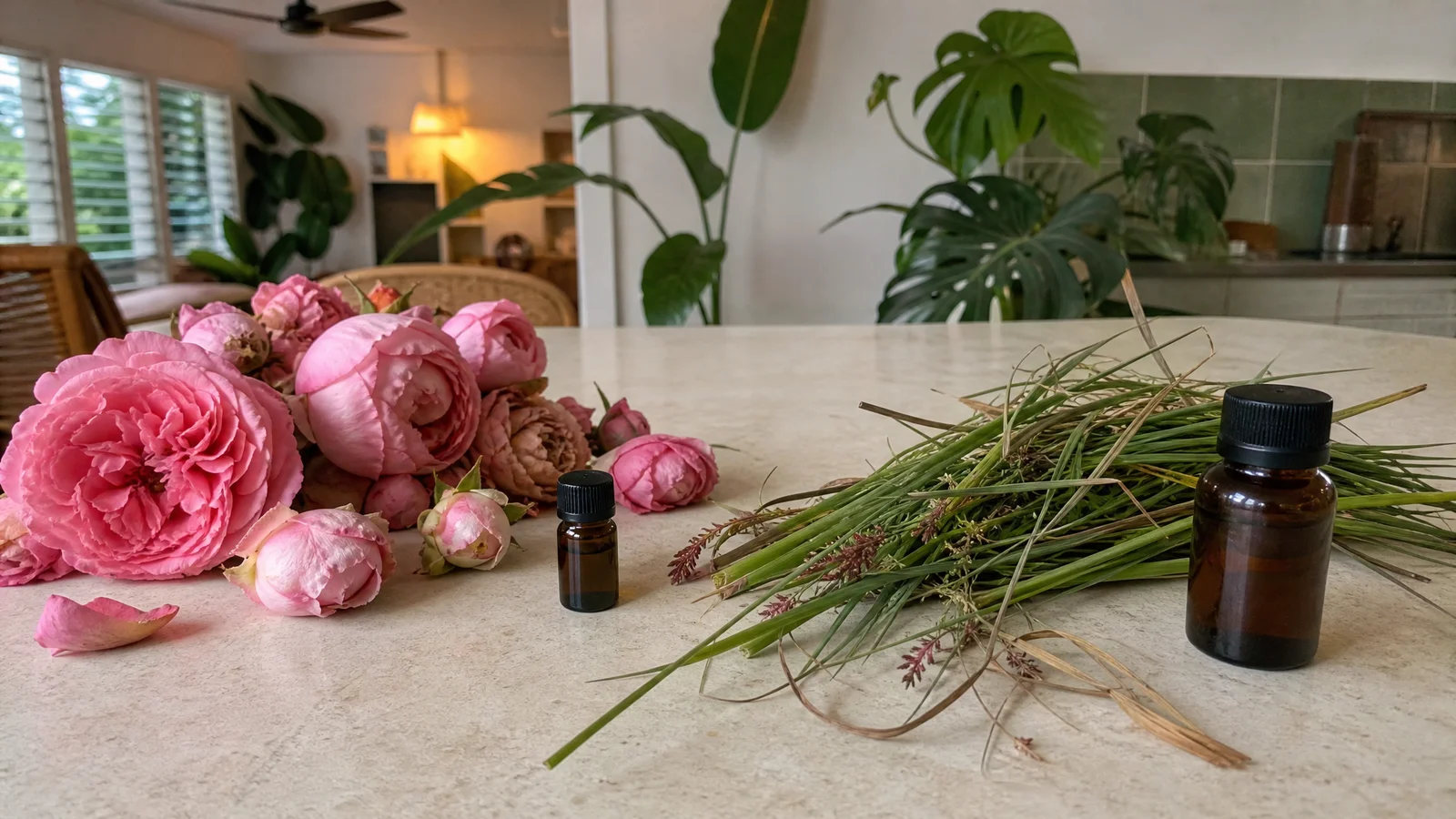
Palmarosa, geranium and bergamot together smell like a rose garden at the edge of a meadow: rosy and green at the heart, with a bright citrus lift on top. It is a lovely idea, and it is worth a little arithmetic because one of the three has a limit that is easy to overlook. This is a formulation worked out on paper from published guidance.
Palmarosa Essential Oil
Our own Palmarosa Essential Oil, in sizes from 0.5 oz to bulk.
From $10.99
Shop Now →Smelling the three
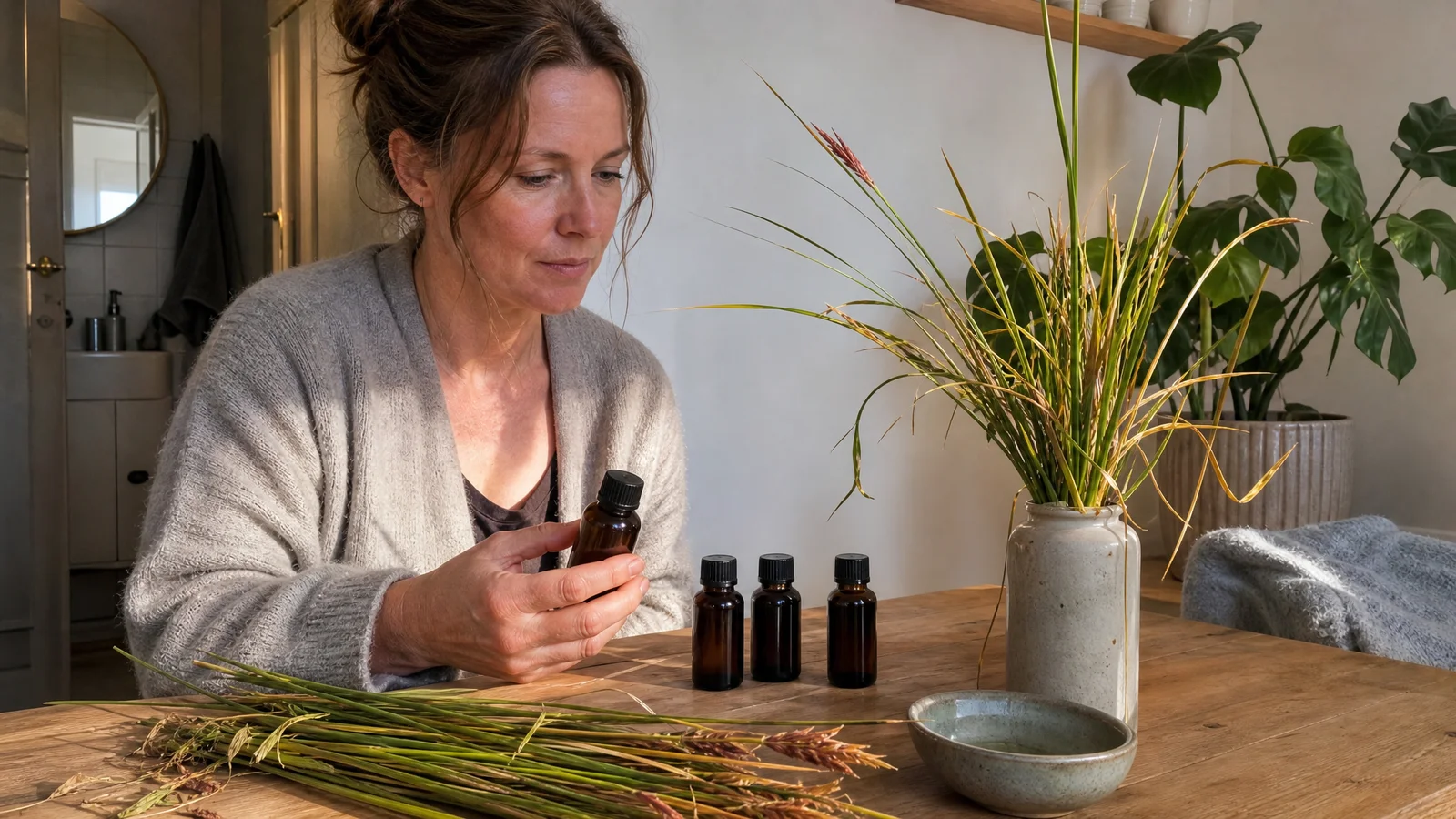
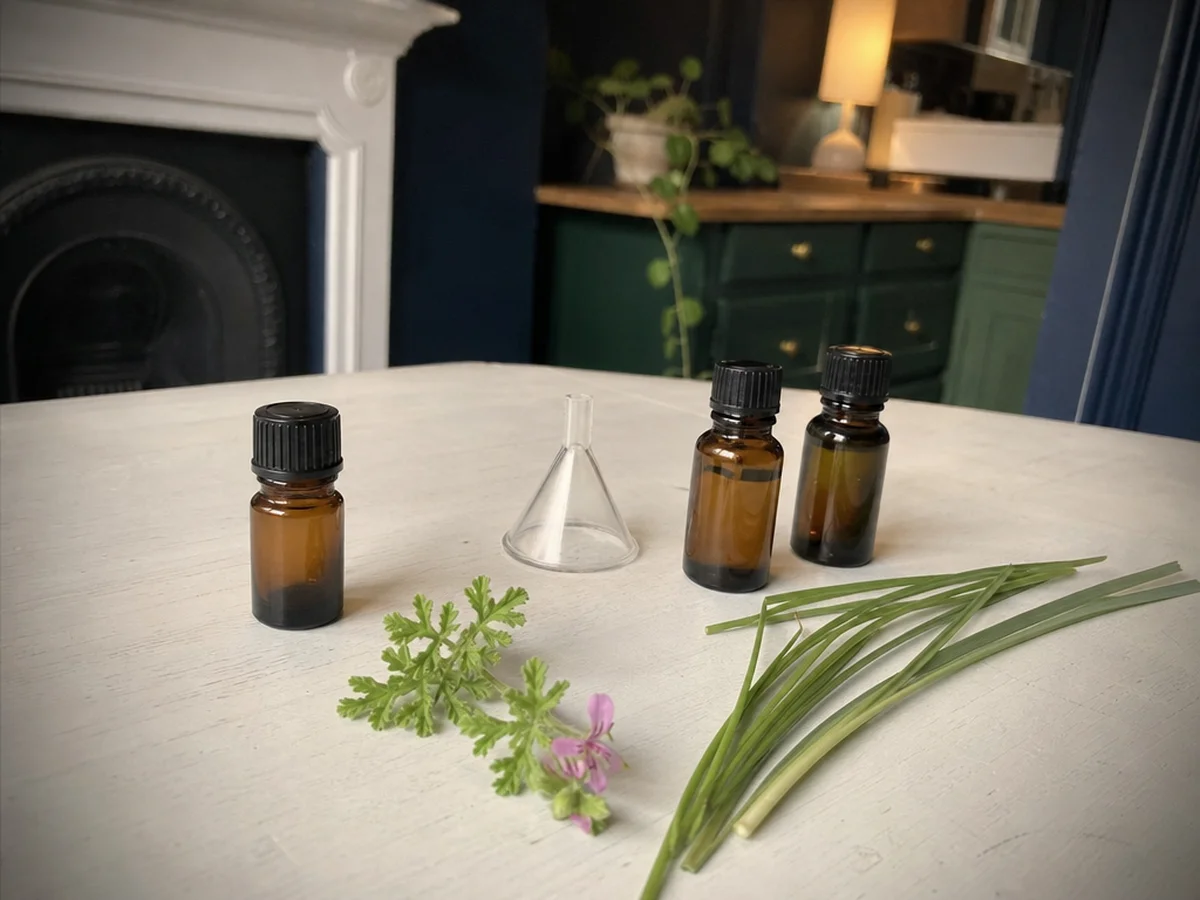
Before you mix anything, open each bottle in turn and smell it on its own. Palmarosa leads with a sweet, rosy note and a green streak, geranium rounds the middle, and bergamot sits on top like sunlight. Then bring the bottles together and notice how the picture changes. Knowing each voice makes it much easier to judge the blend later.
The ratio
We suggest 2 parts palmarosa, 1 part geranium and 1 part bergamot, by drops. Our palmarosa is a middle note described as sweet, rosy and gently green, and it blends well with both partners. Palmarosa and geranium share a rose-green backbone, so they reinforce each other, while bergamot brings a bright top without adding to the rosy weight. We sell palmarosa only; geranium, bergamot and a carrier oil such as jojoba or sweet almond come from an aromatherapy supplier, craft shop or pharmacy. Use an oil-only carrier, since water would call for a preservative.
What sets the strength
IFRA's typical figures put geraniol at 82.4% in palmarosa oil, 17.7% in geranium and next to nothing, 0.04%, in expressed bergamot (Annex on contributions from other sources to the IFRA Standards). Weighted by the ratio, the blend is about 45.6% geraniol, so each 1% of blend in a finished product carries about 0.46% geraniol. IFRA's geraniol standard caps the finished product at 1.2% for body creams, oils and lotions and 0.78% for facial moisturizers (IFRA Standard: Geraniol), with the categories described in IFRA's own guidance (Guidance for the use of IFRA Standards). Dividing gives about 2.6% blend for a body oil and 1.7% for a face oil.
Then comes bergamot. IFRA limits expressed bergamot to 0.40% in the finished product across the skin categories, and that limit applies when the furocoumarin level is unknown (IFRA Standard: Bergamot oil expressed). Bergamot is a quarter of this blend, so it caps the whole blend at 0.40 divided by 0.25, which is 1.6%. That is a lower ceiling than the geraniol maths gives for a body oil, and it sits just under the 2% top of our dilution range. We therefore treat 2% as too strong for this particular blend. These are the 2020 bergamot texts, so check the current standard before formulating for anyone but yourself.
The drops, for a 30 ml bottle
At the common rule of 20 drops to the millilitre, each drop is about 0.17% of a 30 ml bottle. Droppers vary, so a scale is better if you have one.
| Drops (palmarosa / geranium / bergamot) | Blend in carrier | Geraniol | Bergamot |
|---|---|---|---|
| 4 (2 / 1 / 1) | 0.67% | 0.30% | 0.17% |
| 8 (4 / 2 / 2) | 1.33% | 0.61% | 0.33% |
Both rows sit inside the body-oil and face-moisturizer geraniol caps and under the bergamot limit. Our suggestion is 4 drops for a gentle, close scent and 8 for a more present one, and we would stop there. Twelve drops is the 2% mark, which goes over the bergamot figure, so we leave it off. If the oil will go on skin that will be in sun, leave the bergamot out and use palmarosa and geranium at 2 to 1, which keeps the rose and drops the citrus lift.
Mixing it
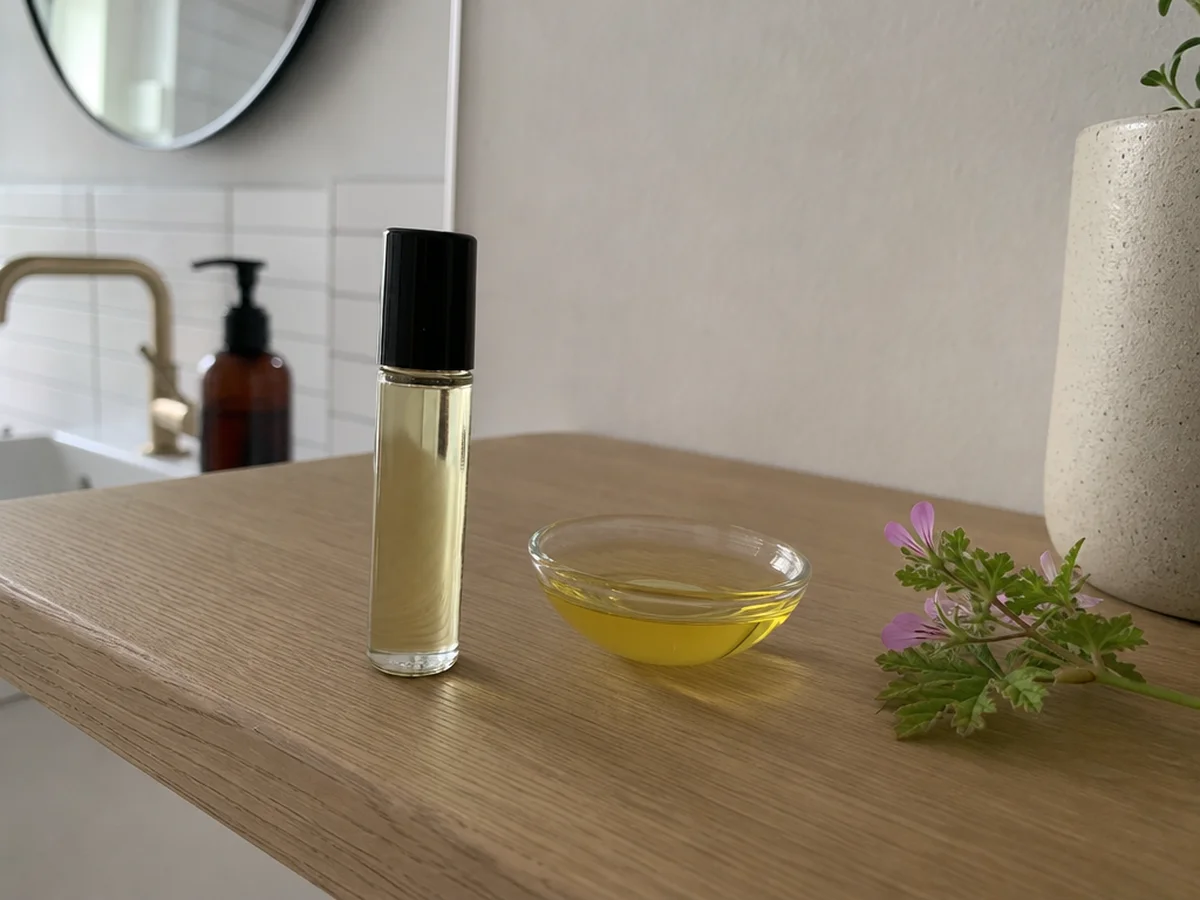
- Start with a clean, dry bottle, ideally dark glass, with a dropper or a roller fitting.
- Count the drops of each oil into the empty bottle first.
- Add the carrier oil up to the line, cap it and tip it gently a few times.
- Label it with the ratio, the strength and the date, and leave it for a day before the first wear.
If you want to change the ratio, rework the sums above before you change a single drop. The bergamot limit is the one that is easiest to cross by accident.
A patch test first, and a diffuser option
We recommend a patch test before wider use, and if you have had fragrance reactions or eczema, a dermatologist is the right person to ask before a three-oil blend. Our patch testing article goes through it. Keep the blend away from children and pets.
The same 2 : 1 : 1 ratio works in a diffuser, where the skin limits do not apply. Follow the device manual for the number of drops, and see palmarosa in summer for run times. For more pairing ideas, there is the pairing guide, the comparison palmarosa versus geranium, and three 10 ml formulas in roll-on blends.
Keep it fresh
A blend of three oils is worth keeping well. Store it tightly capped, out of direct light and away from heat, and make a small bottle you will finish in a few weeks rather than a big one that sits. A cupboard shelf beats a bathroom windowsill every time.
If you make it as a gift, tuck a small card in with the bottle that lists the three oils, the strength and the date, and say plainly that it is for skin only after a patch test. It is a kind thing to do, and it keeps the blend in good hands.
Make it small, make it gently, and the rose meadow arrives without any shouting.
Palmarosa Essential Oil
Palmarosa Essential Oil from our own shop, in sizes from 0.5 oz to bulk.
From $10.99
Shop Now →Sources & Further Reading
- IFRA Standard: Geraniol, IFRA, 51st Amendment, 2023
- Annex on contributions from other sources to the IFRA Standards, IFRA, 51st Amendment, 2023
- Guidance for the use of IFRA Standards, IFRA, 2023
- IFRA Standard: Bergamot oil expressed, IFRA, 49th Amendment, 2020